
How to Make an AI-Drafted Personal Statement Sound Like You
Used ChatGPT for your personal statement? Rewrite it in your own voice, add real stories, and drop the generic AI tone admissions readers spot.
Admissions readers go through hundreds of personal statements every season. They can't always tell whether a draft started in ChatGPT. What they can tell, almost instantly, is when a statement sounds like nobody in particular. Phrases like "ever since I was young, I have been passionate about" or "this experience taught me the value of perseverance" blur together. A statement that blends in is a statement that gets forgotten.
Using AI to brainstorm or outline isn't the problem. Many universities now publish policies that allow some AI assistance and forbid others, so check yours first. The real risk is submitting text that has lost the one thing a personal statement exists to show: you. This guide walks through how to turn an AI draft into a statement that sounds like a specific person with specific experiences.
Why AI personal statements sound generic
Large language models predict the most likely next word. In a personal statement, "most likely" means "most common", and that is the opposite of memorable. Typical giveaways include:
- Abstract openings. "Throughout my life, I have always been fascinated by…"
- Stacked virtues. Resilience, passion, leadership and curiosity, all in one paragraph.
- Tidy lessons. Every story ends with a neat moral.
- Even rhythm. Sentences of similar length and structure, paragraph after paragraph.
- No sensory detail. Nothing you can see, hear or smell.
AI detectors look for similar patterns. Our AI detector highlights the phrases and rhythm that read as machine-like, so you can see where a draft sounds generic. Detectors are not perfect, though. Read how accurate AI detectors are before trusting any single score.
Step 1: Check your school's AI policy
Before you rewrite anything, know the rules. Some programmes allow AI for brainstorming and grammar checks. Others ban it entirely, and some ask you to declare any use. Follow the policy of every school you apply to. A humanized draft that breaks a rule is still a broken rule.
Step 2: Replace every abstract claim with a scene
This is the single most powerful edit. Go through the draft and highlight every sentence that *tells* a quality. Then replace it with a moment that *shows* it.
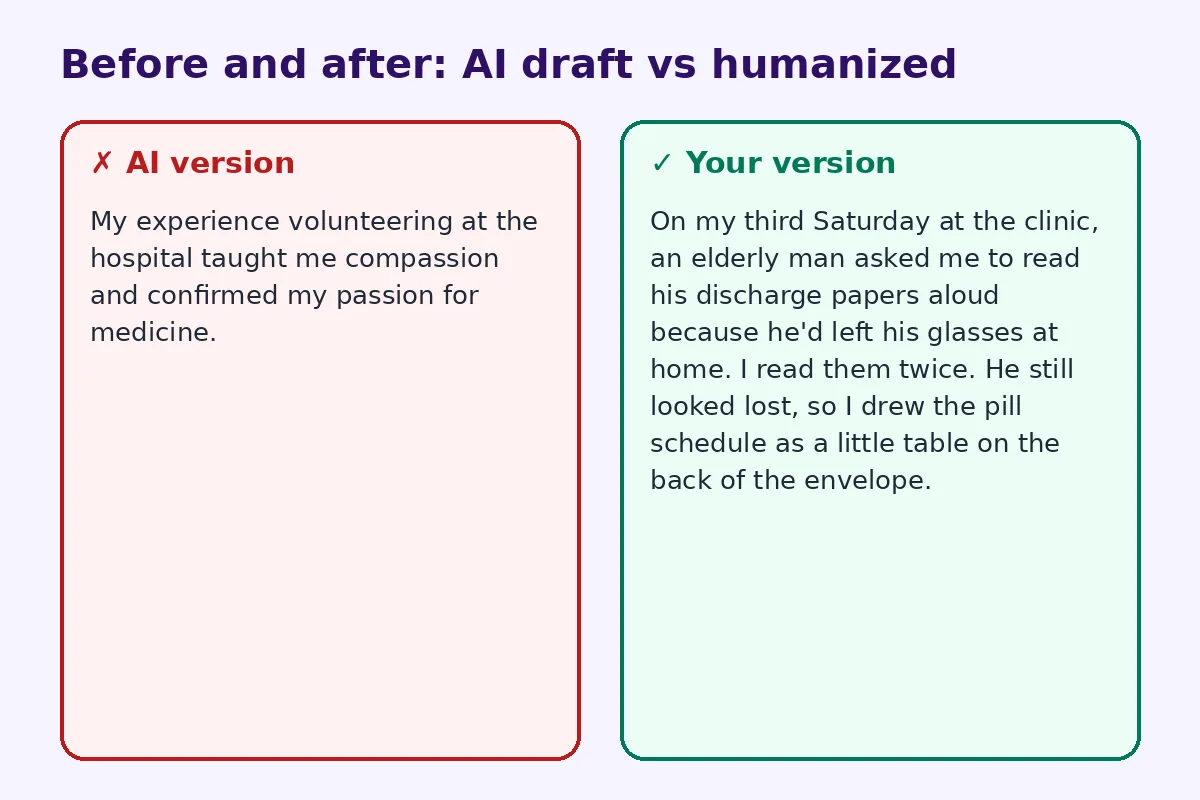
AI version:
My experience volunteering at the hospital taught me compassion and confirmed my passion for medicine.
Your version:
On my third Saturday at the clinic, an elderly man asked me to read his discharge papers aloud because he'd left his glasses at home. I read them twice. He still looked lost, so I drew the pill schedule as a little table on the back of the envelope.
The second version proves compassion without naming it. Only you can write it, because only you were there.
Step 3: Rewrite the opening and closing yourself
AI loves a broad opening and a sweeping conclusion. Start instead in the middle of something: a conversation, a mistake, a place. End on a forward-looking detail rather than a summary of lessons.
Write these two paragraphs from scratch, without looking at the AI draft. They carry the most weight with readers.
Step 4: Put your own voice back in
Read the draft aloud. Anywhere you stumble, or think "I'd never say that", rewrite it the way you'd explain it to a friend. Then:
- Vary sentence length. Put a short sentence after a long one. It adds energy.
- Use your real vocabulary. If you'd never say "multifaceted", cut it.
- Keep one or two quirks. A particular phrase, some humour, a specific obsession. These make you memorable.
- Cut filler transitions. "Furthermore", "moreover" and "in conclusion" rarely appear in real voices.
Our guide to rewriting a ChatGPT essay in your own voice has more exercises that also work for statements.
Step 5: Use a humanizer carefully, as a helper, not the author
A tool like the free AI humanizer can smooth stiff phrasing and break up robotic rhythm. It keeps facts and names intact. Use it on sections that still feel mechanical after your own edit, then review every change. Never paste the output straight into an application without reading it. The goal is your voice, not a different machine's voice.
If you're a student using these tools for coursework too, see AI humanizer for students for guidance on responsible use.
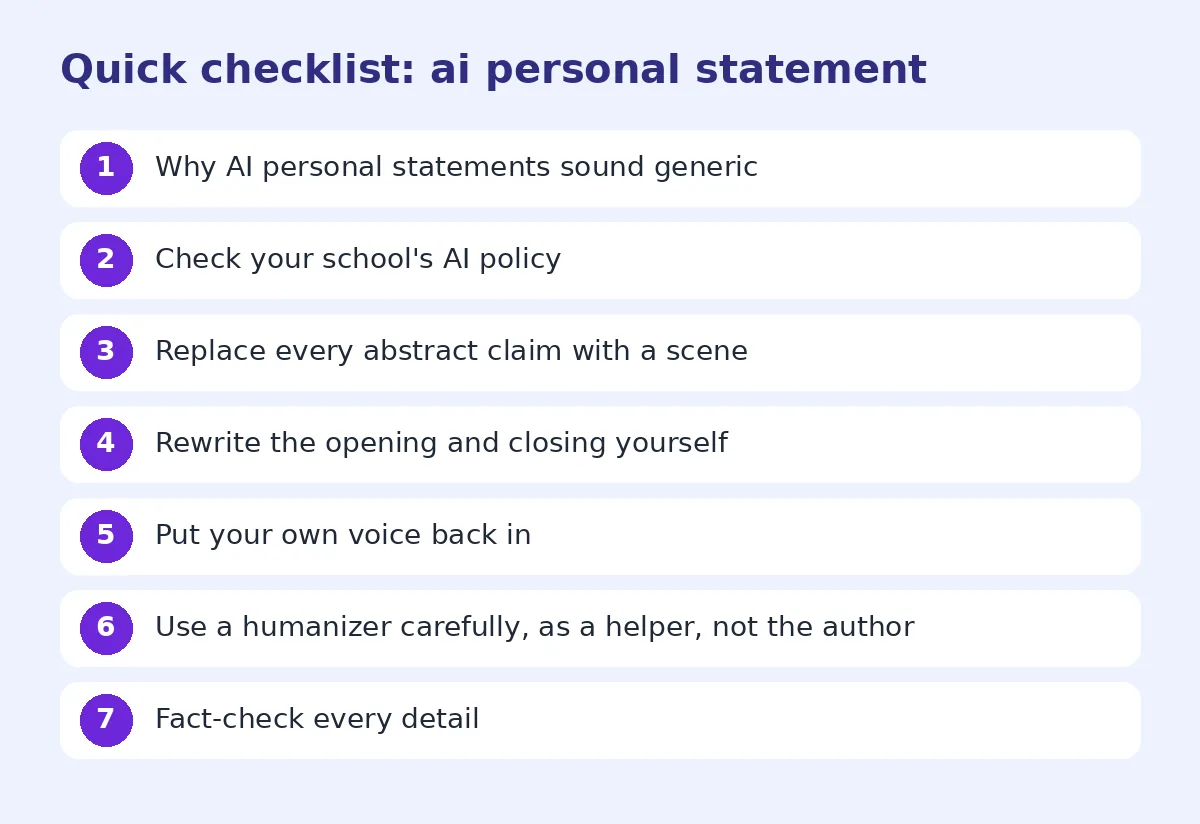
Step 6: Fact-check every detail
AI drafts sometimes invent details, such as an award you didn't win, a date that's wrong, or a course you never took. Admissions officers may check, and interviewers may ask. Delete anything that isn't exactly true.
Step 7: Get a human reader
Ask a teacher, counsellor or friend one question: "Does this sound like me?" If they hesitate, find the paragraphs that don't, and rewrite those. Real readers catch flatness that tools miss.
Before-and-after example
AI draft (generic):
Growing up in a multicultural household, I developed a deep appreciation for diverse perspectives, which has shaped my desire to study international relations and make a positive impact on the world.
Humanized (specific):
At our dinner table, arguments happened in three languages. My grandmother switched to Urdu when she was losing, and my dad switched to English when he wanted to sound official. I learned early that the same point lands differently depending on who's listening, and that's most of what diplomacy is.
Same idea, but now it belongs to someone.
Quick checklist before you submit
- [ ] Follows each school's AI policy
- [ ] Opening starts with a real moment
- [ ] Every claimed quality is shown through a scene
- [ ] No sentence you wouldn't say out loud
- [ ] All facts are true and checkable
- [ ] A trusted reader says "this sounds like you"
- [ ] Word count meets the prompt limit
What detectors can and can't tell you
Some applicants run their final statement through a detector "just to be safe." That can be useful as a style check, because a high AI score usually points at the generic phrasing you'd want to cut anyway. But don't panic over one number. Detectors produce false positives on formal, carefully edited writing, especially from non-native English speakers. If you want to understand the limits, read is my essay flagged as AI? and the comparison of GPTZero vs Turnitin vs Originality.
The best protection is a draft full of details only you could know. No detector flags a memory.
Some programs let you attach a portfolio or a resume. If yours does, see how to add a QR code to your resume so reviewers can open your work samples without typing a long link.
FAQ
Is it allowed to use ChatGPT for a personal statement?
It depends on the institution. Some allow brainstorming or grammar help, and others prohibit any AI use. Always check each school's published policy.
Can admissions officers detect AI-written personal statements?
Some schools use detection software, but more often readers simply notice generic writing. Specific, personal detail is the best way to make a statement stand out and read as genuine.
Will a humanizer make my statement undetectable?
A humanizer improves rhythm and phrasing, but it can't add your experiences. Real stories and your own voice matter far more than any tool.
How do I keep my statement within the word limit after adding stories?
Cut abstract sentences first. Each scene you add usually replaces two or three generic lines, so the length often stays the same.
Should I tell schools I used AI?
If a school asks for disclosure, be honest. Follow their instructions exactly.
Is FreeHumanizerAI free for long statements?
Yes. It's free with no sign-up, and each session allows up to 5,000 words, which is more than enough for any personal statement.
Try FreeHumanizerAI for free
Humanize AI text instantly. No signup, up to 5,000 words per session, and your text is not stored.
Open AI HumanizerRelated guides
- GuideHow to Rewrite a ChatGPT Essay in Your Own Voice (Without Losing the Argument)Used ChatGPT for a first draft? Here is how to make the essay yours, keep the argument, and stay inside your course's AI policy.Read
- GuideIs My Essay Flagged as AI? Why It Happens and What to DoFalse positives are common with formal, well-structured essays. Here is why it happens, how to document your own work, and how to fix the writing.Read
- GuideHow Accurate Are AI Detectors? What the Numbers Really MeanA detector score is a statistical guess about word patterns. Here is how the main tools work, where they fail, and what a 60% actually tells you.Read