
How to Humanize an AI Research Abstract Without Losing Precision
AI abstracts sound vague and generic. Learn how to humanize an AI research abstract with clear aims, real results and precise wording.
The abstract is the most-read part of any research paper. Reviewers, editors and other researchers decide in a few seconds whether to read further. So when an abstract starts with "In recent years, there has been growing interest in this crucial and multifaceted field", many readers move on. That kind of sentence is common in AI-drafted abstracts, and it wastes the most valuable space in your paper.
Many researchers use AI tools to help summarize their work, translate drafts, or polish language. That can be fine within your institution's and journal's rules. But an AI draft needs careful editing to become a strong abstract. This guide shows how to make it clear, specific and recognizably yours.
First: know the rules
Journals, universities and conferences have different policies on AI. Some allow AI for language editing with disclosure. Some ban AI-generated text. Almost all require that the authors take full responsibility for the content. Check your target journal's author guidelines and your institution's academic integrity policy before using any tool, and disclose AI use where required.
A humanizer or editing tool should never be used to hide AI-generated content where it isn't allowed. It should help you communicate your own research clearly.
Why AI abstracts are weak
AI-drafted abstracts tend to share these problems:
- Long, empty openings. "In today's rapidly evolving world..."
- Vague claims. "This study provides valuable insights" without saying what they are.
- Missing numbers. No sample size, effect sizes or key results.
- Inflated language. "Groundbreaking", "pivotal", "paradigm-shifting".
- Generic conclusions. "Further research is needed."
- Incorrect details. AI can invent methods or results that aren't in your paper.
That last point is the most dangerous. Always check every fact in an AI-drafted abstract against your paper.
What a strong abstract includes
Most abstracts follow a structure like this, whether or not it is labeled:
- Background: one or two sentences on the problem.
- Aim: what the study set out to do.
- Methods: design, sample, setting, key measures.
- Results: the main findings with numbers.
- Conclusion: what the results mean and why they matter.
Many journals require structured abstracts with these headings. Follow the format and word limit exactly.
Before and after: a real rewrite
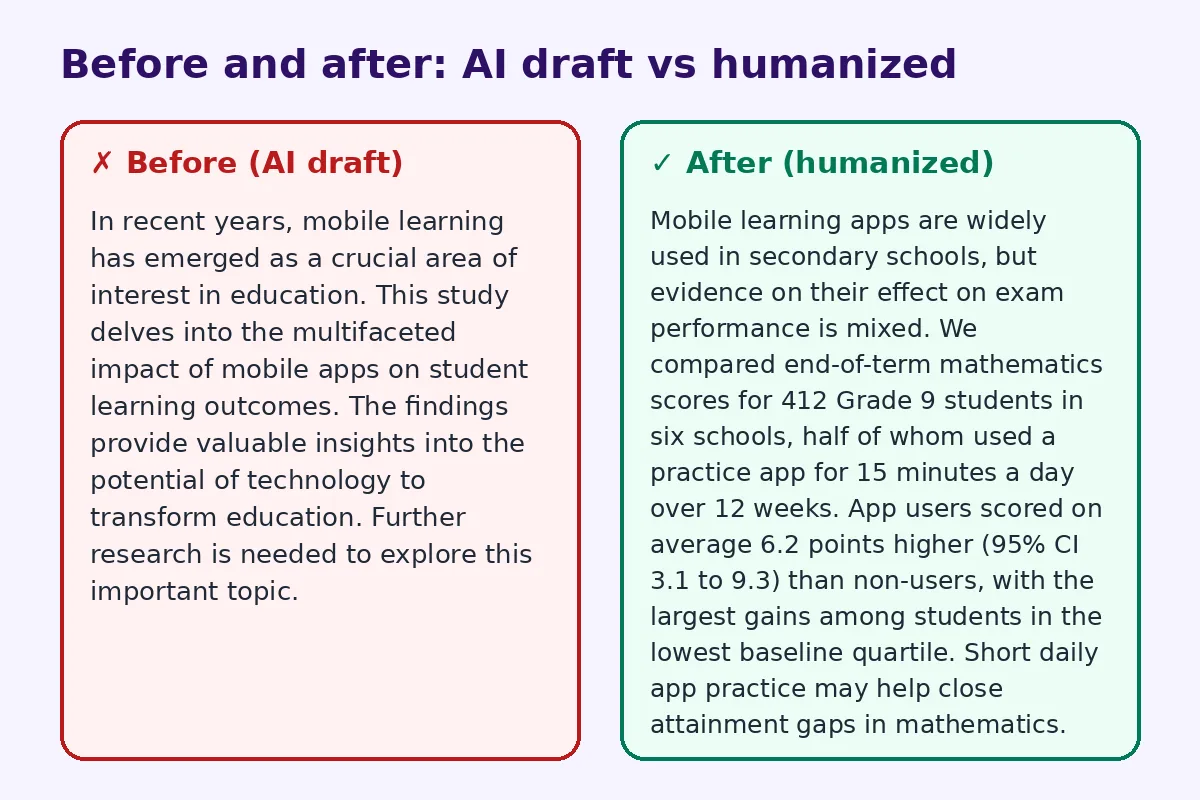
Before (AI draft):
In recent years, mobile learning has emerged as a crucial area of interest in education. This study delves into the multifaceted impact of mobile apps on student learning outcomes. The findings provide valuable insights into the potential of technology to transform education. Further research is needed to explore this important topic.
After (humanized):
Mobile learning apps are widely used in secondary schools, but evidence on their effect on exam performance is mixed. We compared end-of-term mathematics scores for 412 Grade 9 students in six schools, half of whom used a practice app for 15 minutes a day over 12 weeks. App users scored on average 6.2 points higher (95% CI 3.1 to 9.3) than non-users, with the largest gains among students in the lowest baseline quartile. Short daily app practice may help close attainment gaps in mathematics.
The humanized version has a clear problem, a method, a sample size, a result with numbers and a specific conclusion.
Step 1: Write the key facts yourself
Before using any tool, write in plain notes:
- The problem, in one sentence
- Your research question or aim
- Design, participants, setting and time frame
- The two or three main results, with numbers
- The main conclusion and its limits
These notes are the truth of your paper. The abstract must match them exactly.
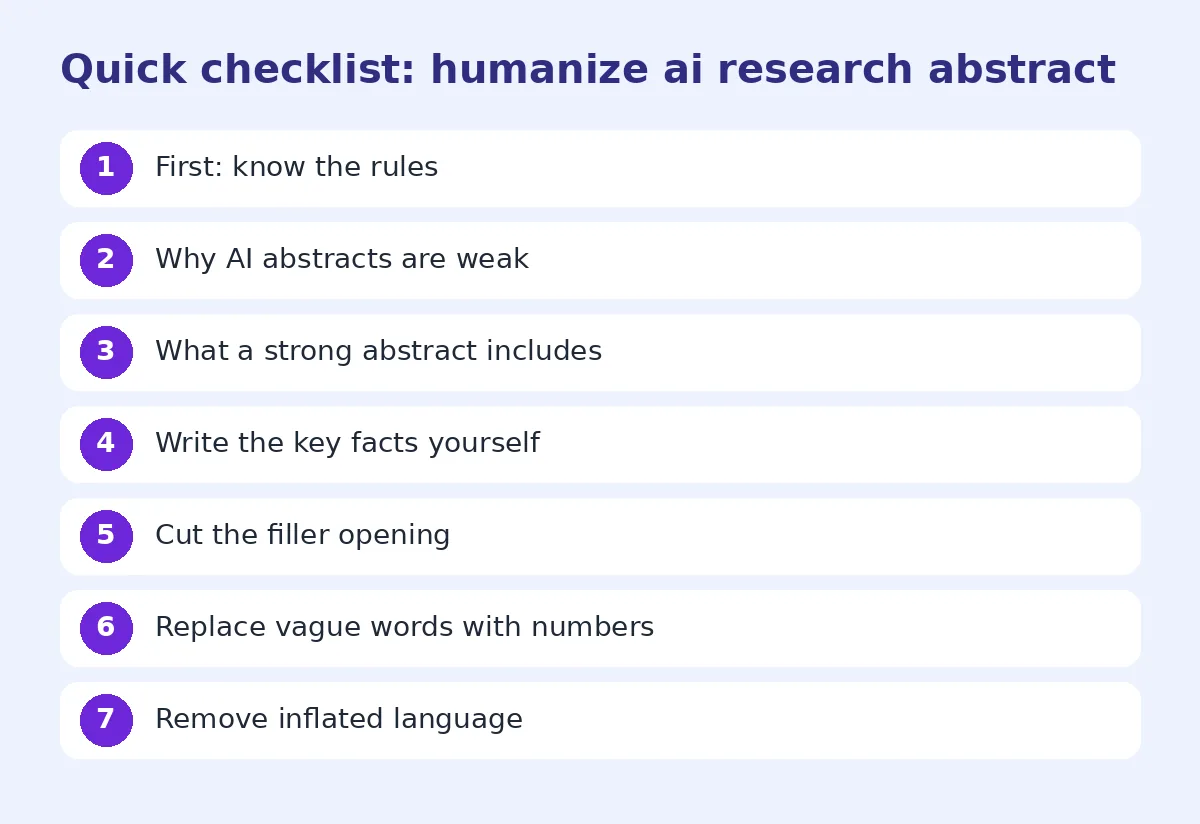
Step 2: Cut the filler opening
Delete "In recent years", "In today's world" and "It is widely known that". Start with the specific problem. Readers in your field already know the general background.
Step 3: Replace vague words with numbers
Change "a significant improvement" to the actual improvement and statistic. Change "a large sample" to "412 students". Change "several countries" to "five countries in Southeast Asia". Specific numbers make abstracts credible and searchable.
Step 4: Remove inflated language
Words like "groundbreaking", "pivotal", "delve", "multifaceted" and "paradigm" often signal AI writing and overstate findings. Reviewers dislike them. Our list of words that make text sound like AI includes many academic examples.
Step 5: Make the conclusion specific
"Further research is needed" says nothing. Say what your results suggest, for whom, and with what limitation: "Results suggest short daily app practice may benefit lower-achieving students; a randomized trial is needed to confirm causality."
Step 6: Check terminology and voice
Use the standard terms of your field and keep them consistent. Many journals now accept active voice ("We compared..."), which is often clearer than passive voice. Match the style of recent abstracts in your target journal.
Step 7: Check against the word limit
Abstracts usually have strict limits, often 150 to 300 words. AI drafts may be too long or too short. Every sentence should earn its place.
Thesis and dissertation abstracts
The same rules apply to thesis abstracts, which are often longer and less structured. For students in the Philippines and elsewhere, our guide on how to humanize a thesis draft covers the full document, including chapters and literature reviews.
About AI detectors
Some journals and universities check submissions with AI detectors. These tools have known false positive problems, especially for non-native English writers and formal academic text. Our article on how accurate AI detectors are explains the limits. The best approach is transparency: follow the rules, disclose AI use where required, and make sure the writing reflects your own work.
Using a humanizer responsibly
If you're a non-native English speaker using AI for language help, an AI humanizer can make phrasing sound more natural after you've written the content. Treat it like a language editor. Check that technical terms, numbers and claims are unchanged afterwards, because any rewriting tool can alter meaning.
Get feedback from a colleague
Before you submit, ask a colleague who is not a co-author to read only your abstract. Then ask them three questions: What did the study do? What did it find? Why does it matter? If they can answer clearly, your abstract works. If they hesitate on any of these, revise that part. This short test catches vague wording and missing results faster than rereading it yourself.
Common mistakes
- Results that don't match the paper.
- No numbers in the results section.
- Long background, short results.
- Overstated conclusions.
- Exceeding the word limit.
- Abbreviations that aren't defined.
A final checklist
- Problem stated in one or two sentences
- Clear aim
- Methods with design, sample and setting
- Main results with numbers
- Specific, honest conclusion
- Within word limit and journal format
- Every fact checked against the paper
FAQ
Can I use AI to write my research abstract?
It depends on your journal and institution. Many allow language editing with disclosure. You remain responsible for the content.
How long should a research abstract be?
Usually 150 to 300 words. Follow the journal's limit exactly.
What should a research abstract include?
Background, aim, methods, main results with numbers, and a conclusion.
How do I make my abstract sound less like AI?
Cut filler openings, add specific numbers, remove inflated words and make the conclusion precise.
Do journals check abstracts for AI?
Some use AI detection tools, though they aren't fully reliable. Follow disclosure rules.
Try FreeHumanizerAI for free
Humanize AI text instantly. No signup, up to 5,000 words per session, and your text is not stored.
Open AI HumanizerRelated guides
- GuideHow to Rewrite a ChatGPT Essay in Your Own Voice (Without Losing the Argument)Used ChatGPT for a first draft? Here is how to make the essay yours, keep the argument, and stay inside your course's AI policy.Read
- GuideHow Accurate Are AI Detectors? What the Numbers Really MeanA detector score is a statistical guess about word patterns. Here is how the main tools work, where they fail, and what a 60% actually tells you.Read