How to Make an AI-Written Speech Sound Natural When You Say It
Wrote a speech with ChatGPT? Rewrite it so it sounds natural out loud, from wedding toasts to work talks, with before-and-after examples.
ChatGPT can draft a wedding toast, a retirement tribute or a five-minute work presentation in seconds. Read silently, the draft often looks polished. Read aloud, it often falls flat. The sentences run long, the phrases sound like a greeting card, and you stumble over words you would never normally say.
That's because writing for the eye and writing for the ear are different skills. AI tools are trained mostly on written text, so their drafts follow written rules. This guide shows how to turn an AI speech draft into something that sounds like you, standing up and talking to people you care about.
Why AI speeches sound wrong out loud
- Sentences are too long. Written text can carry 30-word sentences. Spoken, listeners lose the thread.
- Too many abstract words. "Journey", "cherish", "testament" and "unwavering" sound inflated when spoken.
- No pauses built in. Real speech has short beats where people laugh, react or breathe.
- Generic stories. "John has always been there for everyone" means nothing. A specific Tuesday when John drove three hours with a spare tyre means everything.
- Lists of three, everywhere. AI loves "kind, generous and loyal." Once is fine. Five times is a pattern people notice.
Step 1: Read the AI draft aloud before changing anything
Record yourself on your phone and play it back. Mark every place where you:
- ran out of breath
- tripped on a word
- felt embarrassed by a phrase
- noticed your attention drifting
Those marks are your edit list.
Step 2: Cut long sentences in half
Spoken sentences should usually be under 15–20 words. Split anything longer. You can even use fragments. In speech they sound natural.
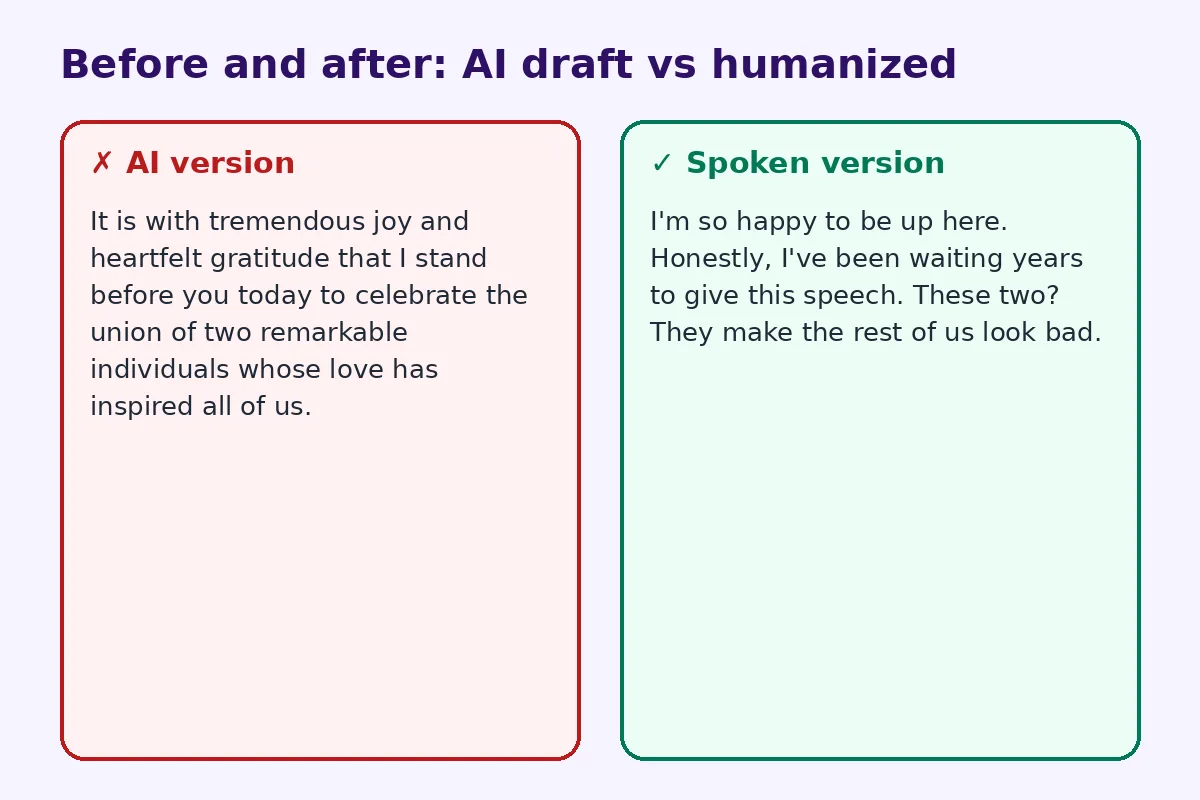
AI version:
It is with tremendous joy and heartfelt gratitude that I stand before you today to celebrate the union of two remarkable individuals whose love has inspired all of us.
Spoken version:
I'm so happy to be up here. Honestly, I've been waiting years to give this speech. These two? They make the rest of us look bad.
Step 3: Swap abstract praise for one true story
Every good speech has at least one specific moment. Ask yourself: what is the one story that captures this person? It should have a time, a place and a detail. Something funny, something small, something real.
AI can't supply this, because it wasn't there. Write it yourself, in plain words, the way you'd tell it at dinner.
Step 4: Use words you actually say
Go line by line and replace any word you wouldn't use in conversation:
| AI word | Spoken alternative |
|---|---|
| utilize | use |
| commence | start |
| endeavour | try / project |
| unwavering | steady / always there |
| testament to | shows |
| embark on a journey | start something new |
For more on spotting AI phrasing, see how to make ChatGPT sound human.
Step 5: Build in pauses and reactions
Mark where you'll pause. Add moments for the audience: a question ("Raise your hand if Sam has ever borrowed your car…"), a beat after a joke, or a moment to look at the person you're talking about. Speeches are conversations with a crowd, not essays.
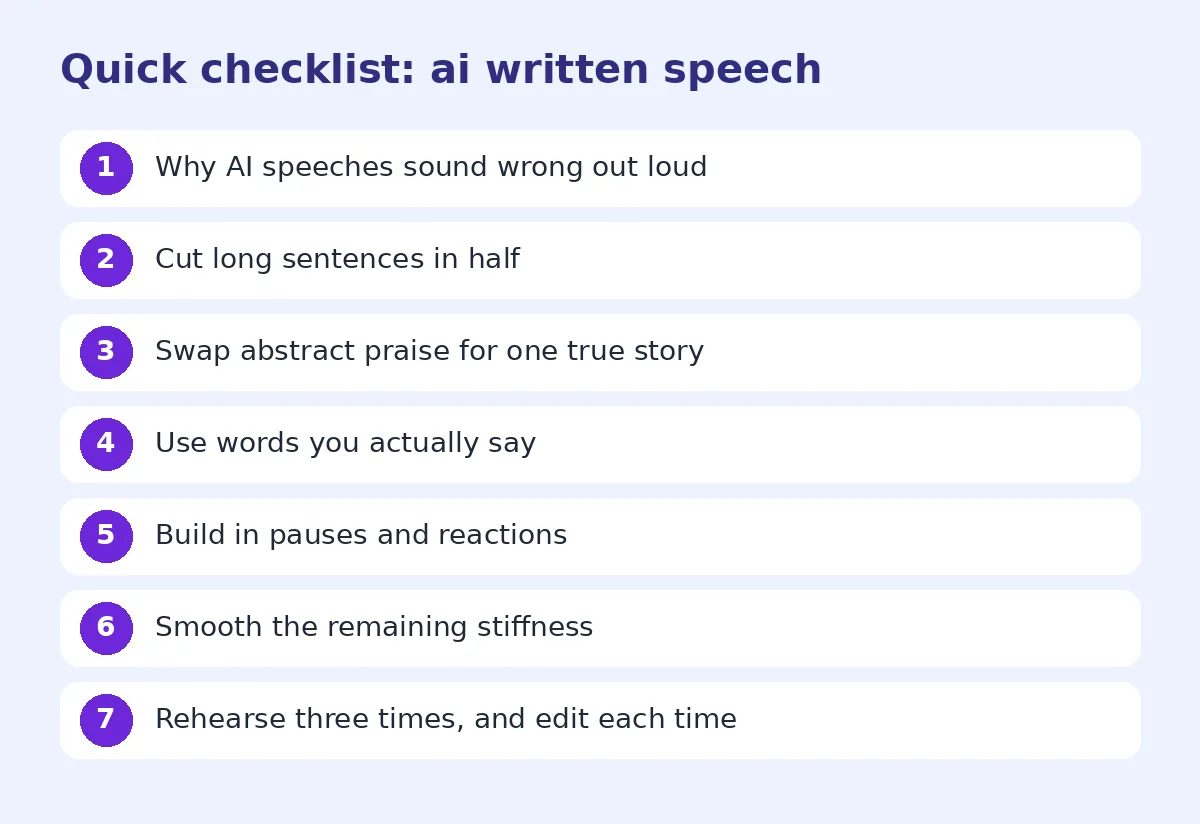
Step 6: Smooth the remaining stiffness
After your own edit, some lines may still feel mechanical. Paste those sections into the free AI humanizer to loosen the rhythm while keeping names and facts. Then read the result aloud again, because the ear is the final judge. You can also use the ChatGPT humanizer page if your draft came straight from ChatGPT.
Never read a humanized output cold on the day. Rehearse it until it's yours.
Step 7: Rehearse three times, and edit each time
- First run: fix anything you stumble on.
- Second run: time it. Most toasts work best at 2–4 minutes, and work updates at 5–7.
- Third run: practise in front of one person, and watch where they smile or drift.
Speech types and what to focus on
Wedding toasts
One story, one joke, one sincere line, and a toast. Avoid inside jokes only three people understand.
Work presentations
Lead with the one thing people should remember. Use plain numbers ("we cut wait times by a third") rather than jargon. For written business content, our guide on humanizing marketing copy covers tone.
Eulogies and tributes
Specific memories matter more than achievements. It's fine to pause. It's fine to be emotional. AI drafts are especially generic here, so lean hardest on your own words.
School and graduation speeches
Talk to your classmates, not at them. Shared moments beat inspirational quotes.
Before-and-after: a retirement speech
AI draft:
Throughout her distinguished 30-year career, Maria has demonstrated unwavering dedication, exceptional leadership, and a commitment to excellence that has left an indelible mark on our organisation.
Spoken rewrite:
Maria started here when we still faxed everything. Thirty years later, she's the reason half of us know how to do our jobs. When I was new, she sat with me for an hour fixing a spreadsheet I'd broken. She never mentioned it again. That's Maria.
Delivery tips that make any script sound more natural
Even a well-edited script can sound robotic if you read it word for word. A few delivery habits help:
- Use bullet cues, not a full script. Once you've rehearsed, reduce the speech to key phrases on a card. You'll naturally say the words in your own way.
- Bold the first word of each section. It helps you find your place after looking up at the audience.
- Slow down. Nerves make everyone speed up. Aim for about 130 words per minute.
- Look at real faces. Pick three friendly people in different parts of the room and talk to them.
- Keep a glass of water nearby. A sip is a natural pause if you lose your place.
- Plan your first and last lines word for word. Strong starts and endings matter most. Everything in between can be a little loose.
If you're nervous about forgetting things, that's normal. The audience wants you to do well, and nobody minds a pause or a glance at your notes. A sincere speech with one stumble beats a flawless speech that sounds like nobody wrote it.
Giving a talk at work or a conference? Put a QR code on your last slide so people can grab your deck or notes. Here is how to turn a PDF into a QR code in a couple of minutes.
FAQ
Is it okay to use AI to write a speech?
Yes, for most personal and work speeches. AI is a useful starting point for structure. Just make sure the final words and stories are yours.
How long should a speech be?
Wedding toasts usually run 2–4 minutes, work presentations 5–10, and eulogies about 3–5. Rehearse with a timer.
Will people notice my speech was written by AI?
They'll notice if it sounds generic. Specific stories and your natural phrasing make it clearly yours.
Can a humanizer fix the whole speech?
A humanizer helps with rhythm and stiff wording, but it can't add your memories. Use it after you've added your own stories.
What's the fastest fix for an AI speech?
Read it aloud and cut every sentence that makes you stumble in half. Then add one real story.
Is FreeHumanizerAI free?
Yes. There's no sign-up, and each session handles up to 5,000 words, which is far more than any speech needs.
Try FreeHumanizerAI for free
Humanize AI text instantly. No signup, up to 5,000 words per session, and your text is not stored.
Open AI HumanizerRelated guides
- GuideHow to Make ChatGPT Sound Human: 9 Edits That Actually WorkChatGPT writes clean, flat prose. These nine edits, from prompt to final read-through, make it sound like a person wrote it.Read
- GuideHow to Humanize an AI YouTube Script (So It Sounds Like You Talking)AI scripts sound stiff when read aloud. Learn how to humanize an AI YouTube script: spoken rhythm, a real hook, personal stories and a read-aloud test.Read
- GuideHow to Edit AI Content to Sound Natural: A Line-by-Line MethodA practical editing checklist for AI drafts, with worked examples. Fifteen minutes per article, no tricks, and the result reads like you wrote it.Read