How to Humanize an AI Wedding Speech So It Sounds Like You
AI wedding speeches sound generic and flat. Learn how to humanize an AI wedding speech with real stories, natural lines and your own voice.
Being asked to give a wedding speech is an honor, and it can also be terrifying. It's no surprise that many best men, maids of honor and parents now start with AI. Type in a few names and you get a full speech in seconds. The problem is that it sounds like every other AI wedding speech: "Love is a journey, and today we celebrate two souls becoming one." "Their love story is truly one for the ages." The room smiles politely, but nobody feels anything.
A great wedding speech is personal, a little funny and short. AI can help you get started, but the parts that make people laugh and cry have to come from you. Here's how to turn an AI draft into a speech that sounds like you and honors the couple.
Why AI wedding speeches fall flat
AI speeches usually have these problems:
- Clichés. "Two souls", "soulmates", "a love for the ages", "the journey of a lifetime".
- No real stories. General praise like "she's kind and caring" without a single moment.
- Generic jokes. Jokes about marriage that could be used at any wedding.
- Too formal. Words you would never say out loud.
- Too long. AI tends to write five-minute speeches. Three minutes is usually better.
What makes a wedding speech work
Most great speeches share a simple structure:
- Introduce yourself. Who you are and how you know the couple.
- Tell one or two stories. Specific moments that show who they are.
- Talk about them as a couple. When you knew they were right for each other.
- A little humor. Kind, not embarrassing.
- A sincere wish. Then raise a glass.
The stories are the heart of it. Everything else is a frame.
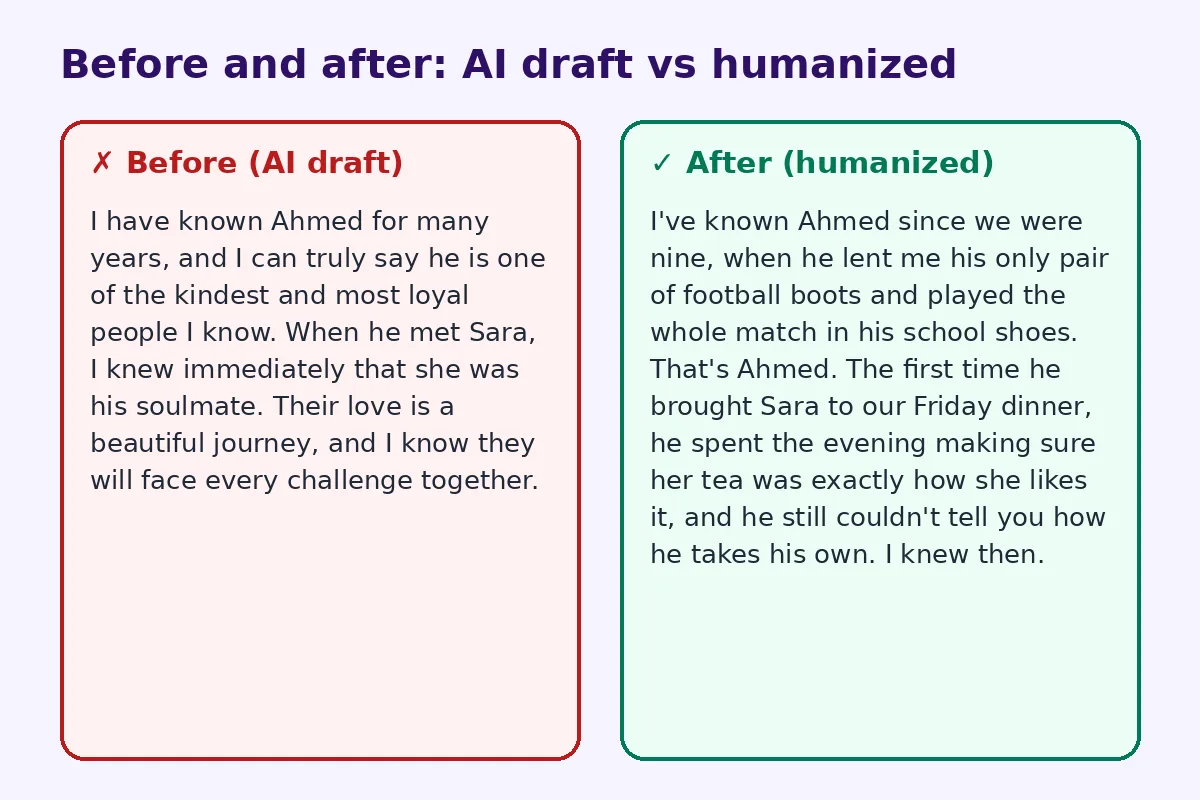
Before and after: a real rewrite
Before (AI draft):
I have known Ahmed for many years, and I can truly say he is one of the kindest and most loyal people I know. When he met Sara, I knew immediately that she was his soulmate. Their love is a beautiful journey, and I know they will face every challenge together.
After (humanized):
I've known Ahmed since we were nine, when he lent me his only pair of football boots and played the whole match in his school shoes. That's Ahmed. The first time he brought Sara to our Friday dinner, he spent the evening making sure her tea was exactly how she likes it, and he still couldn't tell you how he takes his own. I knew then.
The humanized version has a moment, a detail and a laugh. It feels true because it is.
Step 1: Collect your stories first
Before you even open the AI tool, write down:
- How you met the person you're speaking about
- Two or three moments that show their character
- The first time you met their partner, or saw them together
- A habit, phrase or joke that friends will recognize
- What you hope for them
Ask other friends and family for stories too. One great story is better than five average ones.
Step 2: Use AI for the structure, not the content
Give the AI your stories and ask it to organize them: "Here are my notes for a three-minute best man speech. Put them in a good order with a short opening and a toast at the end. Keep my wording where possible. No clichés like soulmates or journey."
You'll get a much better draft than asking it to invent a speech.
Step 3: Remove the clichés
Delete or replace:
- "Two souls becoming one"
- "A love for the ages"
- "Journey", "soulmate", "fairy tale"
- "I can truly say"
- "Without further ado"
Our list of words that make text sound like AI catches more of these.
Step 4: Write for speaking, not reading
A speech is heard, not read. Use short sentences. Repeat names so people follow along. Use contractions: "I'm", "you're", "he's". Read it aloud several times and change anything you trip over.
Step 5: Keep the humor kind
A gentle roast is fine. Embarrassing stories about exes, drinking or anything the couple's grandparents shouldn't hear are not. A good test: would the person you're talking about laugh, or wince?
Step 6: Keep it short
Three to five minutes is ideal, which is roughly 400 to 650 words. AI drafts often run long. Cut anything that isn't a story, a laugh or a sincere moment.
Step 7: Practice
Practice in front of a friend or record yourself. Time it. Mark where you'll pause for laughter. Print it in a large font or use cue cards. Don't read from your phone if you can avoid it.
Speeches for different roles
Best man: One or two stories about the groom, how he changed after meeting his partner, a kind joke, a toast.
Maid of honor: Friendship stories, the moment you knew this was the one, a heartfelt wish.
Parent of the bride or groom: A childhood memory, pride in who they've become, welcoming the new family member.
The couple themselves: Thank guests, thank families, say one personal thing to each other.
For any kind of speech, our general guide on how to humanize an AI speech has more tips on delivery and pacing.
Using a humanizer
If your draft still feels stiff after editing, an AI humanizer can vary sentence rhythm and loosen formal phrasing. But the stories, names and jokes must stay yours. No tool knows the couple like you do.
Wedding planning beyond the speech
Couples are using technology for more than speeches. Many now put a QR code on invitations, table cards and programs that links to RSVPs, schedules, maps and a shared photo album. If you're helping with planning, our sister site's guide to wedding QR codes covers the practical setup. A photo-sharing code is a great thing to mention at the end of your speech too: "Scan the code on your table and share your photos tonight."
Handling nerves on the day
Even a great speech can fall apart if nerves take over. A few simple habits help. Eat something before the reception, and keep your drinks light until after you speak. Hold your notes with both hands if they shake. Pause and breathe before you start, and look for a friendly face in the room. If you lose your place, smile, take a sip of water and find it again. Guests are on your side. They want the speech to go well, and a small stumble often makes it feel more human, not less.
Common mistakes
- Reading an AI speech without changing it.
- Inside jokes nobody else understands.
- Talking about yourself more than the couple.
- Mentioning exes.
- Running over five minutes.
FAQ
Is it okay to use AI to write a wedding speech?
Yes, as a starting point. Replace general lines with your own stories and voice before you give it.
How long should a wedding speech be?
Three to five minutes, or about 400 to 650 words.
How do I make my wedding speech funny?
Use real, kind stories rather than generic jokes, and practice your timing.
What should I avoid in a wedding speech?
Clichés, embarrassing stories, mentions of exes and speeches that are too long.
Should I memorize my wedding speech?
You don't need to memorize it, but practice enough that you can look up from your notes often.
Try FreeHumanizerAI for free
Humanize AI text instantly. No signup, up to 5,000 words per session, and your text is not stored.
Open AI HumanizerRelated guides
- GuideHow to Make an AI-Written Speech Sound Natural When You Say ItWrote a speech with ChatGPT? Rewrite it so it sounds natural out loud, from wedding toasts to work talks, with before-and-after examples.Read
- GuideHow to Make ChatGPT Sound Human: 9 Edits That Actually WorkChatGPT writes clean, flat prose. These nine edits, from prompt to final read-through, make it sound like a person wrote it.Read