How to Make an AI Cover Letter Sound Human (and Actually Get Read)
Turn a ChatGPT cover letter into one that sounds like you. Cut AI phrases, add real proof, fix the opening, and check the tone before you apply.
Using ChatGPT, Claude or Gemini to draft a cover letter is normal now. The problem is that every AI cover letter sounds the same. *"I am thrilled to apply for this exciting opportunity… my unique blend of skills… I am confident I would be a valuable asset to your team."* Recruiters read dozens of these a day, and they've learned to spot them in about two lines.
The fix isn't to stop using AI. It's to treat the AI output as a rough first draft and then make it yours. This guide gives you a practical editing process. It takes about 20 minutes and turns a generic AI letter into one that sounds like a real person applying for a real job.
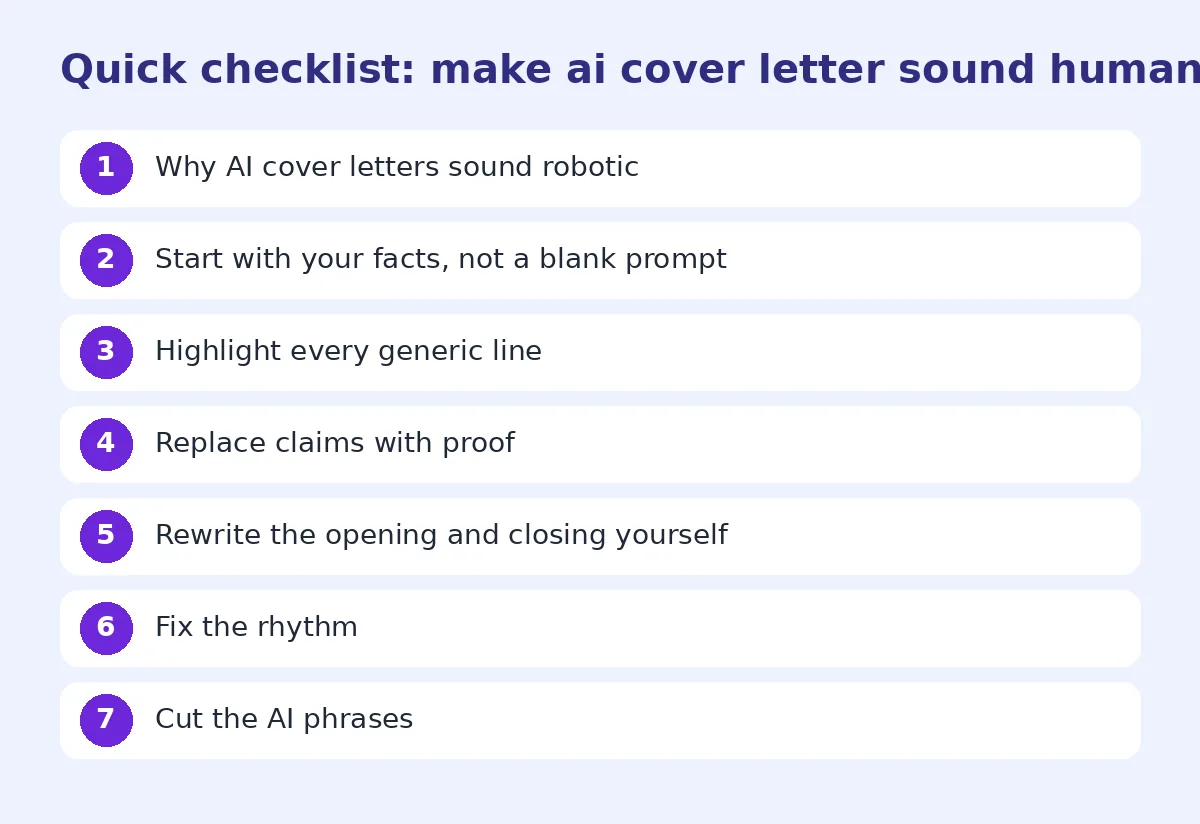
Why AI cover letters sound robotic
AI models write the *most likely* next sentence. For cover letters, the most likely sentences are the ones in millions of templates. That's why AI drafts tend to:
- Open with enthusiasm instead of substance ("I am excited to apply…")
- Make broad claims without proof ("strong communication skills", "proven track record")
- Use the same rhythm in every sentence: medium length, one after another
- Repeat the job advert back to the employer, word for word
- Lean on stock words like *passionate, dynamic, leverage, delve, spearhead, thrilled, unique blend, fast-paced environment*
- Praise the company generically in a way that could fit any employer
None of this is technically wrong. It's just empty, and empty letters don't get interviews.
Step 1: Start with your facts, not a blank prompt
The better your input, the less editing you'll need. Before you prompt, gather:
- Your CV
- The job advert, with 2–3 requirements highlighted
- 3–5 real proof points: projects, results, tools, team sizes or numbers
- One honest reason you want *this* job at *this* company
Then prompt something like: *"Using only the facts below, draft a 250-word cover letter. Don't invent achievements. Where a claim needs evidence I haven't given, write [NEEDS EXAMPLE]."*
That last instruction matters. It stops the AI from making up skills you'll have to defend in an interview.
Step 2: Highlight every generic line
Read the draft and mark each sentence with one of these:
- Keep: specific, true and relevant
- Prove it: a claim that needs an example
- Rewrite: true, but it sounds stiff
- Cut: filler or repetition
A useful test: if the sentence could be sent unchanged to another company, it needs work.
Step 3: Replace claims with proof
This step makes the biggest difference. Recruiters believe examples, not adjectives.
| AI draft | Human version |
|---|---|
| "I have excellent project management skills." | "Last year I ran a six-week CRM migration with sales and support, and we finished a week early." |
| "I am passionate about customer experience." | "I rewrote our refund email templates, and complaint replies dropped by a third." |
| "I thrive in fast-paced environments." | "At a 12-person startup I handled support, onboarding and billing, often in the same afternoon." |
No metric? Use scope instead: who was involved, how long it took, and what changed. Never invent a number.
Step 4: Rewrite the opening and closing yourself
These are the two parts recruiters actually read, and they're where AI is weakest.
Skip: "I am writing to express my interest in the Marketing Coordinator position at [Company]."
Try: Lead with the connection between you and the role. *"I've spent two years running email campaigns for a small skincare brand. Your posting for someone who can own the newsletter end to end is exactly the job I've been doing, minus the title."*
For the close, cut "I look forward to the opportunity to discuss how I can contribute." Say something plain and confident: *"I'd love to talk about how I'd approach your Q1 launch. I'm free most afternoons next week."*
Step 5: Fix the rhythm
AI writes in a steady beat of 15–25-word sentences. People don't. Read your letter out loud. Where it drones, do the following:
- Break one long sentence into two.
- Add a short one. Like this.
- Swap formal phrases for the ones you'd actually say: "utilise" becomes "use", "commence" becomes "start", and "in order to" becomes "to".
- Use contractions where they fit (I've, I'd, it's). Most modern employers find them natural.
Step 6: Cut the AI phrases
Search your letter for these and rewrite or delete them:
thrilled · passionate · dynamic · leverage · synergy · delve · spearhead · unique blend · proven track record · fast-paced environment · valuable asset · I am confident that · exciting opportunity · in today's competitive landscape
You don't have to ban every word. Just make sure none of them is doing the work that a real example should do.
Step 7: Use a humanizer for the last pass (carefully)
Once the facts and structure are yours, a humanizer can smooth out the stiff spots that are left. Paste the letter into the free AI humanizer, choose a professional tone, and use Lite mode for light polishing. Lite keeps your sentences recognisable, while Ultra rewrites more heavily. It's free, with no signup, and your text isn't stored.
Then do these three things:
- Read the output line by line. Make sure every claim is still true and every name and number is unchanged.
- Put back anything that sounds less like you. You're the one who'll be speaking in the interview.
- Run a quick check with the free AI detector if you're curious how machine-like it reads. Don't obsess over the score. A specific letter that sounds like you matters far more than any percentage.
If most of your drafts come from ChatGPT, the ChatGPT humanizer page explains which GPT habits it targets.
Step 8: Final checks before you send
- Is the company name right everywhere? (AI drafts sometimes keep a previous company's name.)
- Did you name the actual role?
- Is it 250–400 words?
- Does every claim match your CV?
- Could you talk about every example for two minutes in an interview?
- Did you read it aloud one last time?
Can recruiters tell a cover letter was written by AI?
Often, yes. They usually can't prove it, but they don't need to. Generic AI letters *feel* generic, and that alone gets them skipped. Some companies run applications through AI detectors, but those tools are probability guesses, not proof, as we explain in how accurate are AI detectors. The real risk isn't getting "caught". It's sounding like everyone else.
A letter built on your own facts and voice doesn't have that problem, however you drafted it.
Before and after: a short example
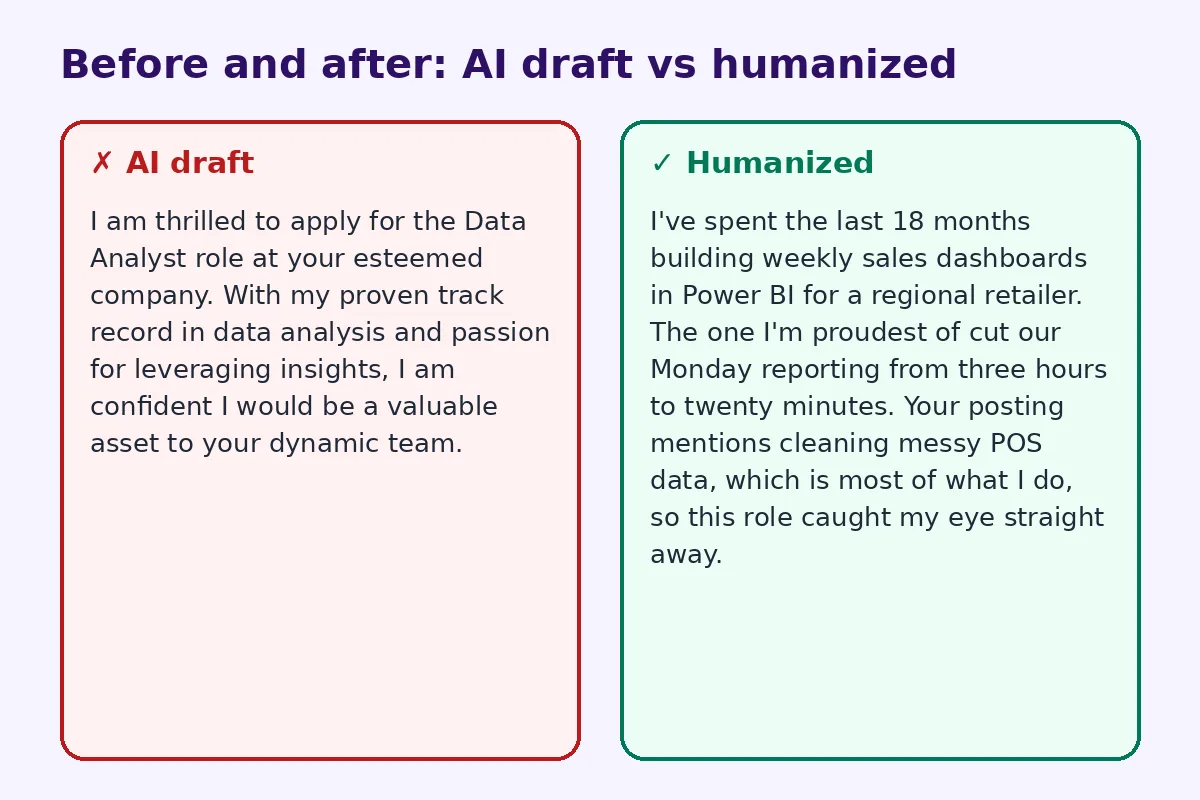
AI draft:
I am thrilled to apply for the Data Analyst role at your esteemed company. With my proven track record in data analysis and passion for leveraging insights, I am confident I would be a valuable asset to your dynamic team.
Humanized:
I've spent the last 18 months building weekly sales dashboards in Power BI for a regional retailer. The one I'm proudest of cut our Monday reporting from three hours to twenty minutes. Your posting mentions cleaning messy POS data, which is most of what I do, so this role caught my eye straight away.
It's the same person and the same job. Only one of these gets read to the end.
One small extra for printed or PDF applications: add a scannable contact card in the header. You can create a free vCard QR code that saves your name, phone and email to a recruiter's phone in one scan.
FAQ
Is it okay to use AI to write a cover letter?
Most employers don't mind AI-assisted drafts, provided the content is accurate and the letter is clearly about you and their role. Use AI to structure and draft, then edit it into your own words.
How do I make a ChatGPT cover letter not sound like ChatGPT?
Replace generic claims with specific examples, rewrite the opening and closing yourself, vary your sentence length, and cut stock phrases like "passionate" and "valuable asset". A humanizer can then smooth the rhythm.
Will an AI humanizer change my facts?
A good humanizer keeps names, numbers and claims. Still, always reread the output and compare it with your CV before you send.
Can an AI detector flag my cover letter even if I wrote it?
Yes. Detectors can flag formal, polished human writing. That's one more reason to keep a natural, specific voice. See is my essay flagged as AI? for why false positives happen.
How long should a cover letter be?
Usually 250–400 words, or three to four short paragraphs. AI drafts often run long, so trimming is part of humanizing.
Should I humanize my CV too?
Bullet points on a CV are meant to be concise, so they need less humanizing. Just make sure each bullet has a concrete result rather than a vague duty.
Try FreeHumanizerAI for free
Humanize AI text instantly. No signup, up to 5,000 words per session, and your text is not stored.
Open AI HumanizerRelated guides
- GuideHow to Make an AI-Written Bio Sound Like YouUsed ChatGPT to write your professional bio or About Me? Rewrite it so it sounds human, with real examples for LinkedIn, websites and speaker bios.Read
- GuideIs My Essay Flagged as AI? Why It Happens and What to DoFalse positives are common with formal, well-structured essays. Here is why it happens, how to document your own work, and how to fix the writing.Read
- GuideHow Accurate Are AI Detectors? What the Numbers Really MeanA detector score is a statistical guess about word patterns. Here is how the main tools work, where they fail, and what a 60% actually tells you.Read