How to Humanize an AI About Us Page So Visitors Trust You
AI About Us pages sound like every other business. Learn how to humanize an AI About Us page with your real story, people and voice so visitors trust you.
The About Us page is often one of the most visited pages on a small business website. People go there to answer a simple question: who is behind this, and can I trust them? Yet many About pages now read like this: "At [Company], we are passionate about delivering innovative solutions that exceed customer expectations. Our dedicated team is committed to excellence in everything we do." It says nothing. Every business could claim the same thing, and visitors leave without feeling any connection.
AI can help you get started, but a good About page needs your real story, real people and real voice. This guide shows how to turn a generic AI draft into a page that builds trust.
Why AI About pages sound empty
AI drafts usually:
- Use corporate buzzwords. "Passionate", "innovative solutions", "committed to excellence", "cutting-edge".
- Skip the story. No mention of how or why the business started.
- Hide the people. No names, faces or roles.
- Make big claims without proof. "Industry-leading", "best-in-class".
- Sound like everyone else. Interchangeable with any competitor.
Our list of words that make text sound like AI includes many of these phrases.
What a great About page includes
- Who you are. A clear one-line summary.
- Your story. How and why you started.
- Who you help. Your customers and what you do for them.
- What makes you different. Specific, provable points.
- The people. Names, roles and a little personality.
- Proof. Numbers, reviews, awards, years in business.
- A next step. Contact, shop, book or subscribe.
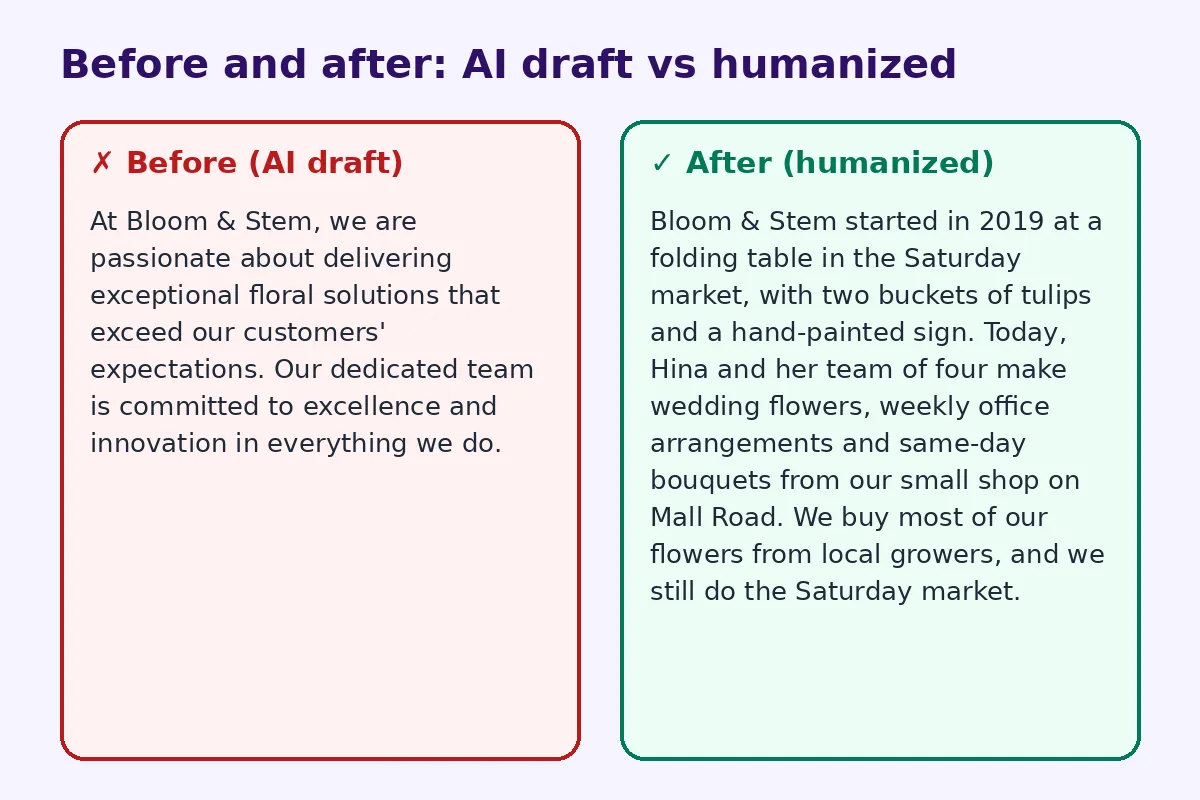
Before and after: a real rewrite
Before (AI draft):
At Bloom & Stem, we are passionate about delivering exceptional floral solutions that exceed our customers' expectations. Our dedicated team is committed to excellence and innovation in everything we do.
After (humanized):
Bloom & Stem started in 2019 at a folding table in the Saturday market, with two buckets of tulips and a hand-painted sign. Today, Hina and her team of four make wedding flowers, weekly office arrangements and same-day bouquets from our small shop on Mall Road. We buy most of our flowers from local growers, and we still do the Saturday market.
The humanized version has a story, real people, a place, specific services and a believable detail that makes it memorable.
Step 1: Gather your real material
Before writing, answer these questions in plain notes:
- When and why did you start?
- What problem were you solving?
- Who are your customers?
- What do you do differently, in specific terms?
- Who is on the team?
- What are you proud of: numbers, milestones, reviews?
- What do you want visitors to do next?
Give these notes to AI if you want a draft, but keep the facts exactly as they are.
Step 2: Start with a clear summary
The first line should tell visitors exactly what you do and for whom: "We're a family-run bakery in Lahore making sourdough and custom birthday cakes since 2016." Avoid vague openers like "Welcome to our story."
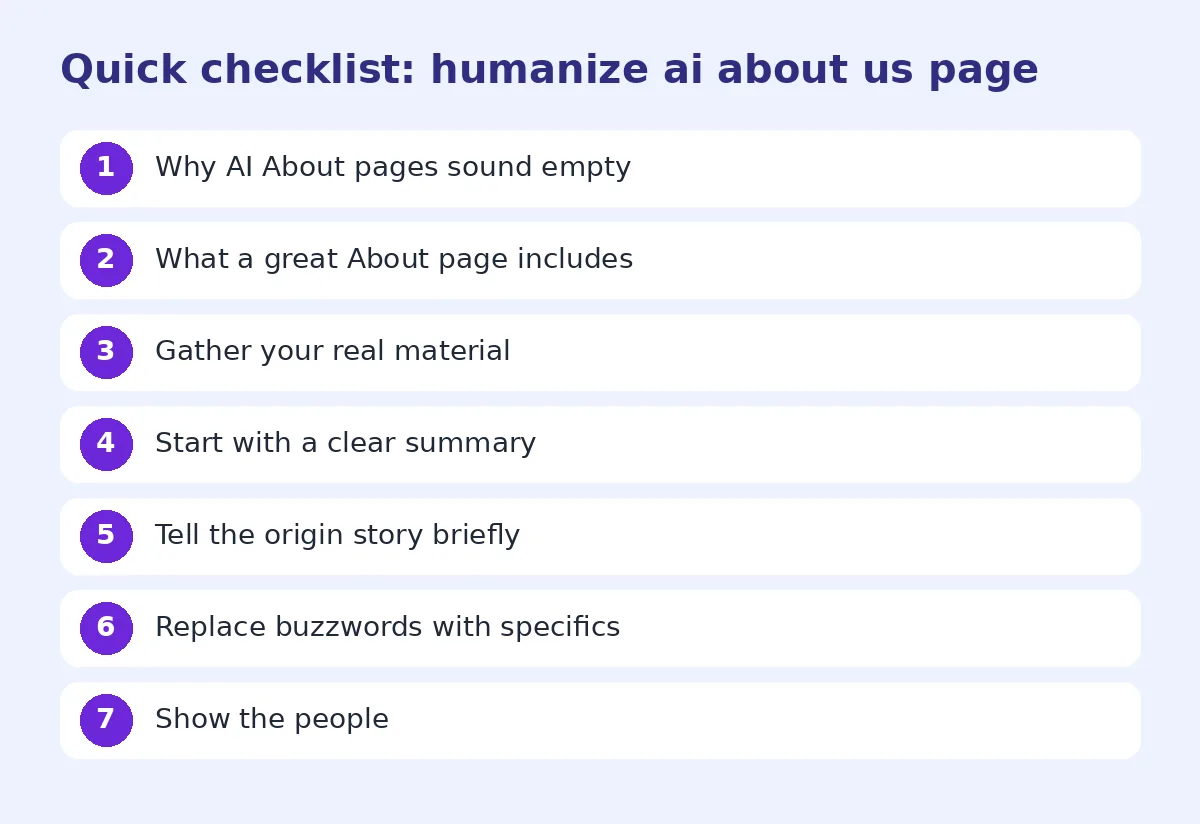
Step 3: Tell the origin story briefly
You don't need a long biography. A few sentences on how you began and why are enough. Real, small details (a kitchen table, a first customer, a mistake you learned from) make it human.
Step 4: Replace buzzwords with specifics
- Instead of "high-quality products," say "hand-stitched leather from a tannery in Sialkot."
- Instead of "excellent customer service," say "we answer every email within one working day."
- Instead of "experienced team," say "our three engineers have fixed over 4,000 laptops."
Step 5: Show the people
Add names, roles and short personal notes. "Ali handles orders and talks to every customer by phone" builds more trust than "our dedicated team." Use real photos of the team and workplace if you can. For individual bios, see our guide on how to humanize an AI bio.
Step 6: Add proof
Include concrete evidence: years in business, customers served, ratings, press mentions, certifications, or a short customer quote. Only use real numbers and real reviews.
Step 7: Write in your natural voice
Read the page out loud. If it sounds like a press release, simplify it. Use "we" and "you". Contractions are fine. A bit of humor is fine if it fits your brand.
Step 8: End with a clear next step
Tell visitors what to do: "Book a free consultation", "See our menu", "Visit us on Saturday" or "Get in touch." Add a button or link.
About pages for different businesses
Freelancer: "I'm a bookkeeper for small cafés and shops in Karachi. I started freelancing after ten years at an accounting firm because I wanted to work directly with owners, not just numbers."
Online shop: "We're two sisters who started making soy candles in our kitchen in 2021. Every candle is poured by hand in small batches, and we test every new scent for a month before selling it."
Service business: "We've been fixing air conditioners in Islamabad since 2012. Our technicians are trained in-house, and we give a written quote before any work starts."
Non-profit: "We run free coding classes for teenagers in three neighborhoods. Last year, 180 students finished our course, and 40 now volunteer as mentors."
Using AI and humanizers responsibly
AI can help organize your notes, suggest structure and tighten wording. Ask for plain, warm language with no buzzwords. Then edit it carefully. An AI humanizer or our marketing copy humanizer can remove leftover robotic phrasing. Never let AI invent history, numbers, awards or testimonials. For more on how search engines treat AI writing, see does Google penalize AI content.
Keep it updated
Update your About page when your team, services or location change. An outdated page with a former employee's photo or an old address quietly reduces trust.
Write for your visitor, not for yourself
A common trap is turning the About page into a list of everything the business has ever done. Visitors don't need your full history. They want to know whether you can help them and whether you're trustworthy. For every paragraph, ask: "Why would a customer care about this?" If the answer is unclear, shorten it or cut it. Your founding story matters because it explains your values. Your team matters because customers want to know who they'll deal with. Your awards matter only if they prove you're good at what the customer needs.
A simple About page outline
If you're starting from scratch, try this order. One sentence on who you are and who you help. A short paragraph on how you started. A paragraph on what you do differently, with two or three specific points. A team section with names, photos and one line each. A proof section with a number and a short customer quote. Then a button with your main call to action. That's often all a small business needs, and it's far more convincing than a long, polished page full of buzzwords.
Common mistakes
- Starting with "Welcome to our website."
- Using only buzzwords.
- No story or people.
- Claims without proof.
- No clear next step.
- Copying a competitor's page structure word for word.
FAQ
Can I use AI to write my About Us page?
Yes, as a draft. Add your real story, people and proof, and edit it so it sounds like you.
How long should an About Us page be?
Usually 300 to 800 words. Long enough to tell your story and build trust, short enough to read quickly.
What should an About Us page include?
Who you are, your story, who you help, what makes you different, your team, proof and a next step.
Should I include team photos?
Yes, if possible. Real photos build trust far more than stock images.
How do I make my About page stand out?
Use specific details and real stories instead of buzzwords.
Try FreeHumanizerAI for free
Humanize AI text instantly. No signup, up to 5,000 words per session, and your text is not stored.
Open AI HumanizerRelated guides
- GuideHow to Make an AI-Written Bio Sound Like YouUsed ChatGPT to write your professional bio or About Me? Rewrite it so it sounds human, with real examples for LinkedIn, websites and speaker bios.Read
- GuideHow to Edit AI Content to Sound Natural: A Line-by-Line MethodA practical editing checklist for AI drafts, with worked examples. Fifteen minutes per article, no tricks, and the result reads like you wrote it.Read
- GuideDoes Google Penalize AI Content? What the Guidelines Actually Say in 2026Google's rule is about helpfulness, not authorship. Here is what the guidelines say, what gets sites hit, and a publishing checklist.Read