
How to Humanize an AI Blog Intro That Actually Hooks Readers
AI blog intros are generic and lose readers fast. Learn how to humanize your blog intro with a real hook, a clear promise and natural wording.
The intro is the most important part of a blog post, and it is where AI is weakest. Ask any AI writer for an article and you will usually get an opening like: "In today's fast-paced digital world, content is king. Whether you're a seasoned marketer or just starting out, understanding X is more important than ever." Readers have seen that sentence on thousands of blogs. Many leave before reaching the second paragraph.
You can still use AI to draft your posts. But the intro deserves a human rewrite. This guide shows how to turn a generic AI intro into one that earns the reader's attention in a few seconds.
Why AI intros fail
AI intros usually make the same mistakes:
- Throat-clearing. "In today's world..." or "Have you ever wondered..." before getting to the point.
- Talking to everyone. "Whether you're a beginner or an expert" means it is speaking to no one.
- No stakes. There is no reason to care right now.
- Overpromising. "Everything you need to know" or "the ultimate guide".
- Filler words. "Crucial", "essential", "delve", "landscape".
Our list of words that make text sound like AI catches most of these.
What a good blog intro does
A good intro does three things in about 60 to 120 words:
- Hooks the reader with something specific: a problem, a surprising fact, a short story.
- Shows you understand the reader's situation.
- Promises what they will get from the post.
That is it. No history of the internet, no definition of the topic everyone already knows.
Before and after: a real rewrite
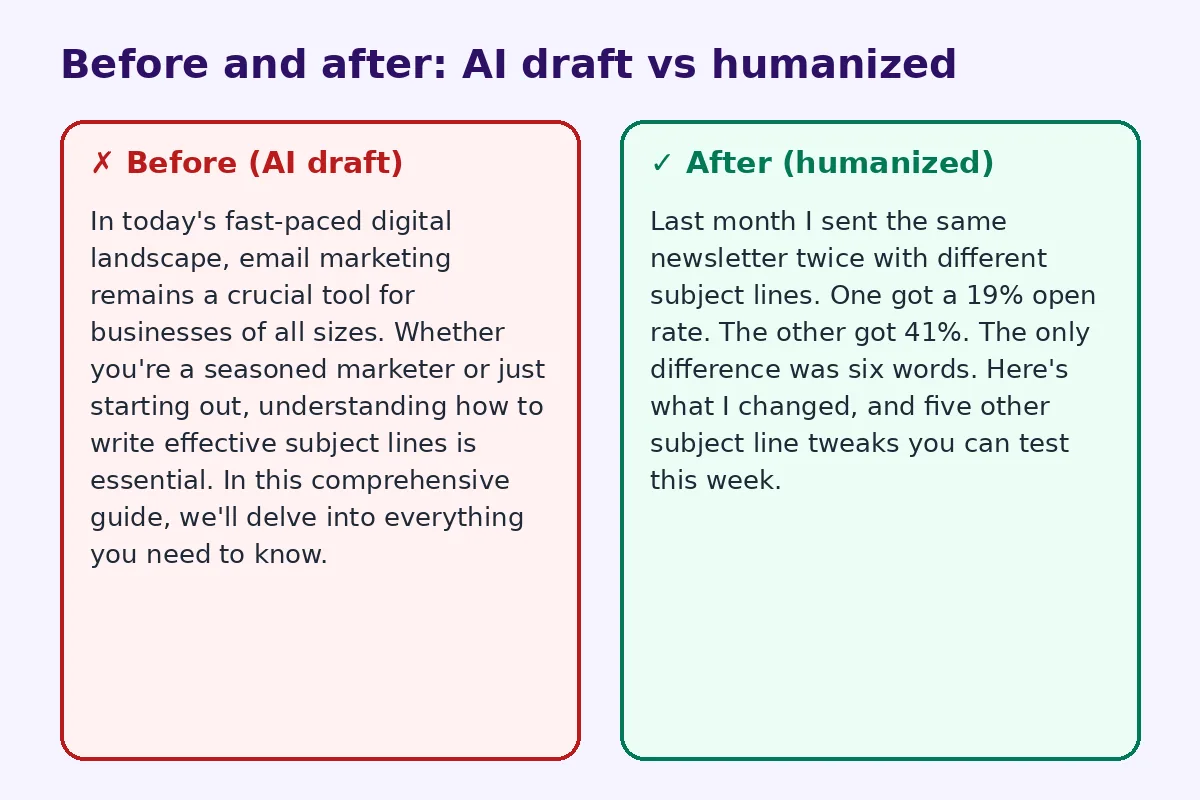
Before (AI draft):
In today's fast-paced digital landscape, email marketing remains a crucial tool for businesses of all sizes. Whether you're a seasoned marketer or just starting out, understanding how to write effective subject lines is essential. In this comprehensive guide, we'll delve into everything you need to know.
After (humanized):
Last month I sent the same newsletter twice with different subject lines. One got a 19% open rate. The other got 41%. The only difference was six words. Here's what I changed, and five other subject line tweaks you can test this week.
The humanized version is shorter, specific, and gives a reason to keep reading.
Step 1: Delete the first sentence
Seriously. In many AI drafts, the first sentence or two are filler. Delete them and see if the intro still works. Usually it works better.
Step 2: Start with something specific
Choose one of these hooks:
- A short story. "Last month I sent the same newsletter twice..."
- A number. "Most visitors leave a blog post in under 15 seconds."
- A problem. "Your AI-written post is accurate, but nobody reads past the intro."
- A bold, honest statement. "You don't need a 3,000-word post to rank."
- A question the reader is already asking. "Why does my blog get traffic but no comments?"
Avoid vague questions like "Have you ever wondered about...?". Make it something the reader would really ask.
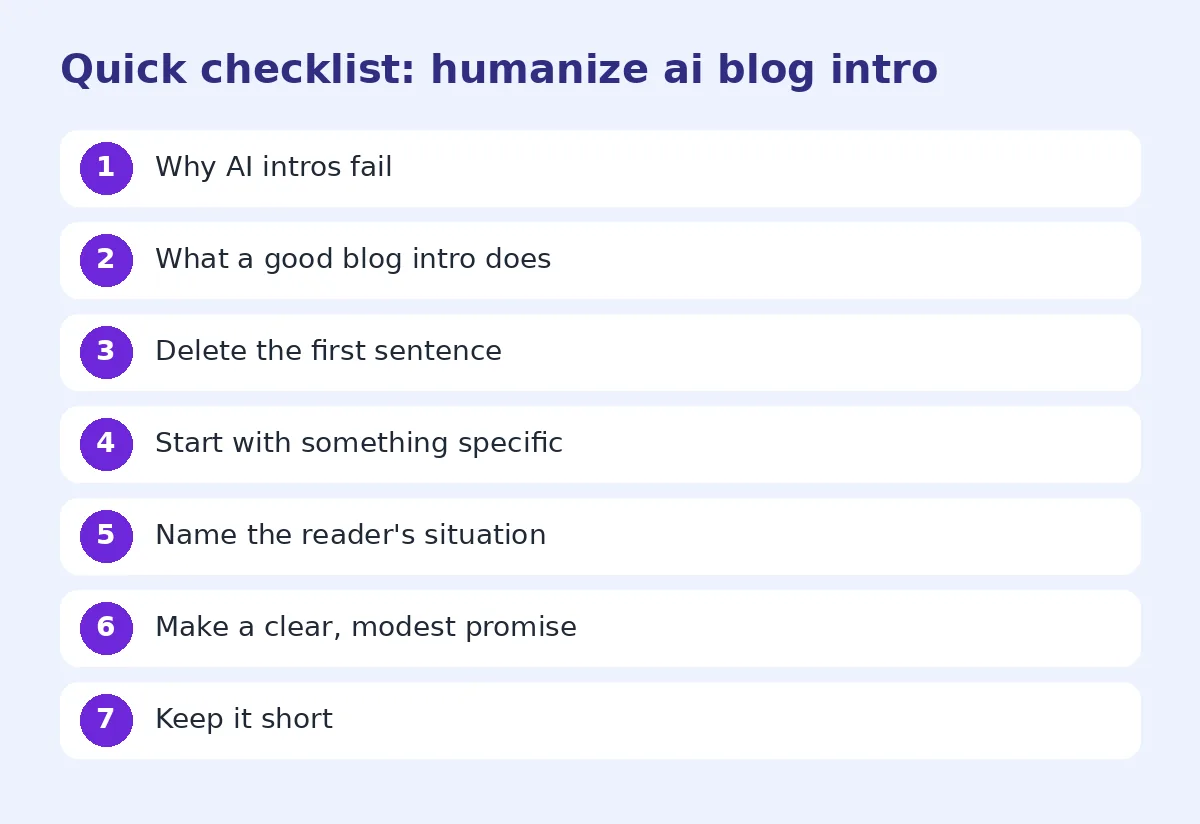
Step 3: Name the reader's situation
Show you understand who is reading. "If you run a small shop and write your own blog posts between orders..." is much stronger than "whether you're a beginner or an expert". Being specific makes the right readers feel seen, and it is fine if others leave.
Step 4: Make a clear, modest promise
Tell the reader what they will get: "Here are five intro formulas, with examples, that you can use today." Avoid "the ultimate guide" or "everything you need to know". A specific, honest promise builds more trust.
Step 5: Keep it short
Your intro doesn't need to explain the whole topic. Aim for two to four short paragraphs. Get to the first heading quickly. Readers who want the details will scroll.
Step 6: Read it out loud
If the intro sounds like a corporate announcement, rewrite it. Use contractions. Vary sentence length. Add a word or phrase you would actually say.
Intro formulas you can reuse
The mini story: "[What happened] + [the surprising result] + [what this post will show you]."
The problem-solution: "[The problem the reader has] + [why common advice fails] + [what this post offers]."
The data hook: "[Surprising number] + [what it means for the reader] + [what to do about it]."
The direct answer: "[Answer the main question in one line] + [why it matters] + [what details follow]."
The direct answer format is great for SEO, because it can show up as a featured snippet.
Use AI to help, not to finish
AI can still be useful for intros if you prompt it well. Try: "Write three different blog intros under 80 words for a post about X. Start with a specific fact or story. No phrases like 'in today's world'. Speak to small business owners." Then pick the best one and edit it.
For the full article, see our guide on how to edit AI content to sound natural. If you blog regularly, our AI humanizer for bloggers can speed up the rewriting of drafts.
Common mistakes to avoid
- Starting with a dictionary definition.
- Repeating the title in the first sentence.
- Writing a long intro before the first heading.
- Promising more than the post delivers.
- Using a hook that has nothing to do with the rest of the article.
Does the intro affect SEO?
Yes, indirectly. A strong intro keeps readers on the page, which is a signal that the content is useful. It is also often used by Google for the snippet shown in results. Put your main keyword naturally in the first paragraph, and answer the main question early. For more on how search treats AI writing, read does Google penalize AI content.
Test your intros
If your blog gets steady traffic, you can learn a lot by watching how readers behave after the intro. Check scroll depth and average time on page for a few posts, then rewrite the intro of the weakest one and compare over the next month. Small changes, like moving the main answer into the first two lines or cutting a long opening paragraph, often make a clear difference. Keep notes on which hook types work best for your audience.
A quick checklist before publishing
- Does the first line say something specific?
- Is it clear who the post is for?
- Is the promise clear and honest?
- Is it under about 120 words?
- Did you remove filler phrases like "in today's world"?
FAQ
How long should a blog intro be?
Usually 60 to 120 words, or two to four short paragraphs.
Can I use AI to write my blog intro?
Yes, as a draft. Then rewrite it with a specific hook, a clear promise and your own voice.
What is the best hook for a blog post?
A specific story, a surprising number or a direct answer to the reader's question usually works best.
Should I put the keyword in the intro?
Yes, naturally, ideally in the first paragraph.
Why do AI intros sound generic?
AI tends to use safe, common phrases and speak to everyone at once. Adding specific details fixes most of the problem.
Try FreeHumanizerAI for free
Humanize AI text instantly. No signup, up to 5,000 words per session, and your text is not stored.
Open AI HumanizerRelated guides
- GuideDoes Google Penalize AI Content? What the Guidelines Actually Say in 2026Google's rule is about helpfulness, not authorship. Here is what the guidelines say, what gets sites hit, and a publishing checklist.Read
- GuideHow to Edit AI Content to Sound Natural: A Line-by-Line MethodA practical editing checklist for AI drafts, with worked examples. Fifteen minutes per article, no tricks, and the result reads like you wrote it.Read
- GuideHow to Humanize an AI Newsletter So People Keep Opening ItAI-written newsletters feel generic and drive unsubscribes. Here is how to humanize an AI newsletter with your voice, real stories and simple edits.Read