How to Humanize an AI Lab Report So It Reflects Your Actual Experiment
AI lab reports sound vague and can break class rules. Learn how to humanize a lab report with your real data, clear methods and your own analysis.
Lab reports are one of the most common assignments in science classes, and one of the most tempting to hand to AI. The trouble is that AI didn't do your experiment. It doesn't know that your solution turned cloudy at 42 seconds, that your second trial was off because the thermometer slipped, or that your group's results didn't match the textbook. An AI lab report reads smoothly, but it's often vague, generic, and sometimes plainly wrong about what happened.
Teachers can usually tell. And more importantly, the lab report is where you show that you understand the science. This guide shows how to use AI responsibly, within your class rules, and how to turn a generic draft into a report that reflects your real experiment and your own thinking.
First, check your class rules
Some teachers allow AI for brainstorming, structure or grammar. Others don't allow it at all. Read your syllabus, ask your teacher if you're unsure, and disclose AI use when required. Whatever the rules, your data, observations and analysis must be your own. Never let a tool invent results.
Why AI lab reports are easy to spot
AI-written lab reports tend to have:
- Generic introductions. "Chemistry is a fascinating science that helps us understand the world."
- Textbook results. Perfect results that match theory exactly, even when real data rarely does.
- Vague methods. "Various materials were used" without amounts or steps.
- No specific numbers. Or invented numbers that don't match your data table.
- Empty error analysis. "Human error may have affected the results."
- Formal filler words. "Furthermore", "it is evident that", "delve", "crucial".
Our list of words that make text sound like AI catches many of these.
The structure of a good lab report
Most lab reports follow this structure (check your teacher's template):
- Title
- Aim or purpose: what you tested.
- Hypothesis: what you predicted and why.
- Materials and method: what you used and what you did, step by step.
- Results: data tables, graphs and observations.
- Discussion: what the results mean, compared to your hypothesis and theory.
- Error analysis: what affected accuracy and how to improve it.
- Conclusion: a short answer to the aim.
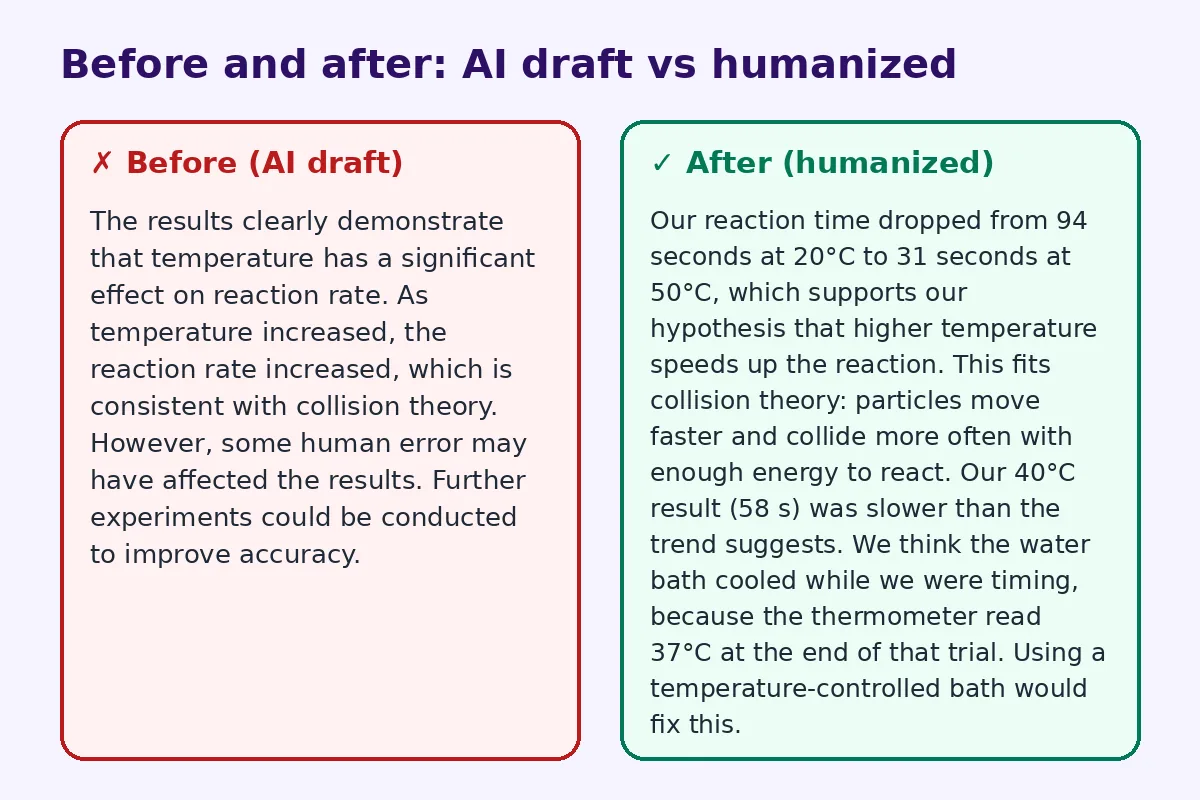
Before and after: a discussion section
Before (AI draft):
The results clearly demonstrate that temperature has a significant effect on reaction rate. As temperature increased, the reaction rate increased, which is consistent with collision theory. However, some human error may have affected the results. Further experiments could be conducted to improve accuracy.
After (humanized):
Our reaction time dropped from 94 seconds at 20°C to 31 seconds at 50°C, which supports our hypothesis that higher temperature speeds up the reaction. This fits collision theory: particles move faster and collide more often with enough energy to react. Our 40°C result (58 s) was slower than the trend suggests. We think the water bath cooled while we were timing, because the thermometer read 37°C at the end of that trial. Using a temperature-controlled bath would fix this.
The second version uses real numbers, refers to an actual problem, and explains the science in the student's own words.
Step 1: Write your data and observations first
Before using any tool, fill in:
- Your data table with all trials
- What you saw, smelled, heard or measured
- Anything that went wrong or surprised you
- Exact amounts, temperatures and times
These are facts only you have. They are the core of your report.
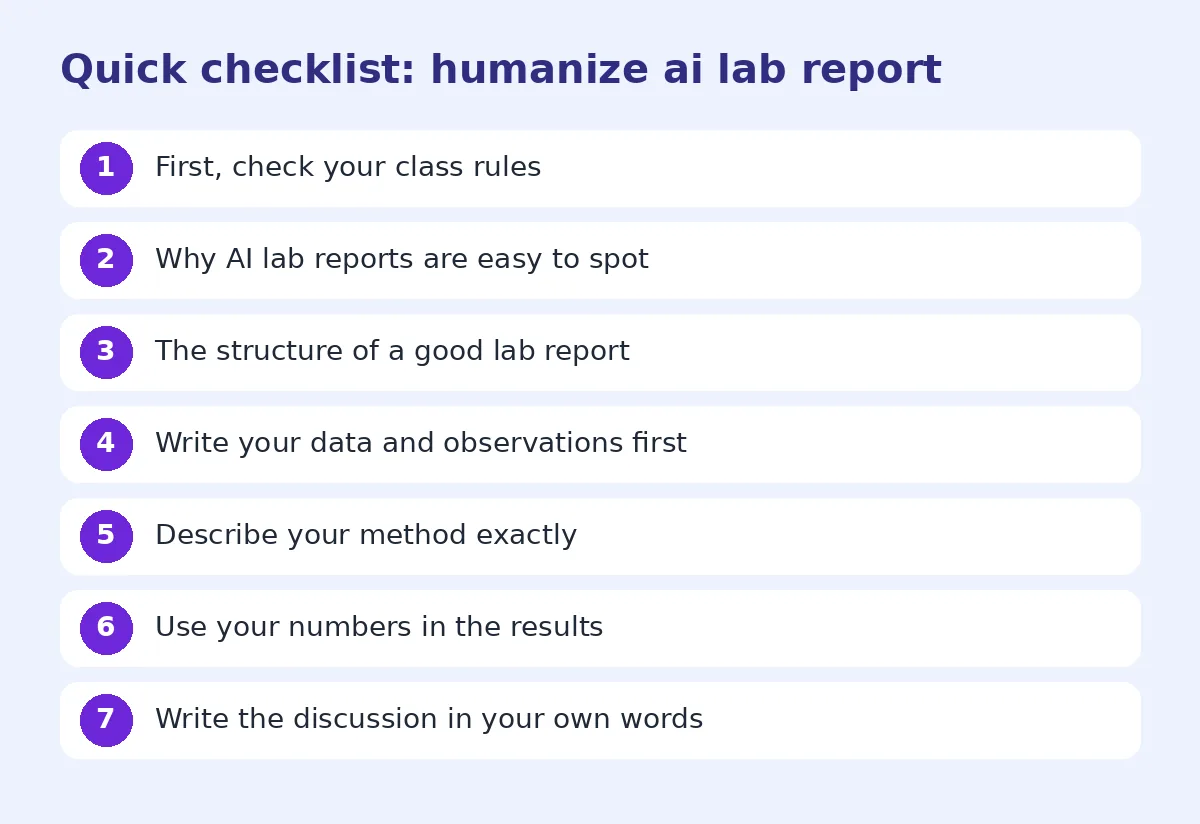
Step 2: Describe your method exactly
Replace vague AI phrases with your actual steps: "We measured 50 mL of 0.1 M hydrochloric acid using a measuring cylinder and poured it into a 250 mL conical flask." Your method should be clear enough that someone else could repeat the experiment.
Step 3: Use your numbers in the results
Every result in your text should match your data table. Refer to specific values: "The average time at 30°C was 72 seconds." Don't round in ways that hide variation, and don't change data to fit the theory.
Step 4: Write the discussion in your own words
Explain what your results show and link them to the science you learned in class. Use your teacher's terms. If your result didn't match the hypothesis, say so and suggest why. Honest discussion of unexpected results usually earns more marks than pretending everything was perfect.
Step 5: Make error analysis specific
"Human error" is not an explanation. Name the actual problem: reaction time when starting the stopwatch, heat loss, inaccurate measuring, contamination. Then suggest a specific improvement.
Step 6: Remove AI filler
Delete phrases like "It is evident that", "Furthermore", "In conclusion, it can be seen that" and "This experiment provides valuable insight". Short, clear scientific sentences are better.
Step 7: Check everything against your notes
AI can invent equipment you didn't use or numbers you didn't record. Read your report side by side with your lab notebook. Every fact must match.
Using a humanizer responsibly
If your teacher allows AI for language help, an AI humanizer for students can smooth phrasing in sections you've written yourself, especially if English is not your first language. Use it only for wording. Check that numbers, units and scientific terms haven't changed afterwards. For broader advice, see our guide on how to rewrite a ChatGPT essay in your own voice.
About AI detectors
Some schools use AI detectors on assignments. These tools can make mistakes and sometimes flag honest work, especially formal scientific writing. Our article on whether Turnitin can detect AI writing explains how they work. The best protection is a report built on your own data and reasoning.
Graphs and tables
Make sure graphs have a title, labeled axes with units, and a clear scale. Tables should have headings and units. AI tools can't see your graph, so write your description of the trend yourself: "The graph shows a steep decrease in reaction time between 20°C and 40°C, then a smaller decrease to 50°C."
Work with your lab partners
Many lab reports are based on group experiments, but you usually write the report on your own. Share data with your partners, but write your own discussion and error analysis. Compare notes on what went wrong during the practical, because each person often notices different things. Talking through the results together is one of the best ways to understand them, and it makes your written explanation much stronger than anything a tool can produce without seeing the experiment.
Common mistakes
- Copying textbook theory without linking it to your results.
- Results that don't match your data table.
- Vague method and error analysis.
- Missing units.
- Writing in a style your teacher knows isn't yours.
FAQ
Can I use AI to write my lab report?
Only if your teacher allows it, and only for structure or language. Your data, observations and analysis must be your own.
How do I make a lab report sound less like AI?
Use your real numbers and observations, describe your exact method, and explain errors specifically.
What should go in the discussion section?
What your results show, how they compare to your hypothesis and theory, and why any results differed.
What is a good error analysis?
Name the specific sources of error and suggest specific improvements.
Will a humanizer change my data?
It can change wording, so always check numbers, units and terms afterwards.
Try FreeHumanizerAI for free
Humanize AI text instantly. No signup, up to 5,000 words per session, and your text is not stored.
Open AI HumanizerRelated guides
- GuideHow to Humanize an AI Research Abstract Without Losing PrecisionAI abstracts sound vague and generic. Learn how to humanize an AI research abstract with clear aims, real results and precise wording.Read
- GuideHow to Rewrite a ChatGPT Essay in Your Own Voice (Without Losing the Argument)Used ChatGPT for a first draft? Here is how to make the essay yours, keep the argument, and stay inside your course's AI policy.Read
- GuideHow Accurate Are AI Detectors? What the Numbers Really MeanA detector score is a statistical guess about word patterns. Here is how the main tools work, where they fail, and what a 60% actually tells you.Read