
How to Humanize AI Product Descriptions So They Actually Sell
AI product descriptions sound generic and hurt sales. Learn how to humanize them with real details, buyer language and a clear voice, with examples.
AI tools can write a hundred product descriptions in a minute. For a small shop with a big catalog, that sounds like a dream. But open any store that relies on raw AI copy and you will see the same thing on every page: "elevate your style", "crafted with care", "the perfect blend of form and function". Shoppers skim straight past it, and search engines see near-duplicate pages across thousands of stores.
The fix is not to stop using AI. It is to use AI for the first draft and then edit it so it sounds like someone who knows the product wrote it. This guide shows you how.
Why AI product descriptions fall flat
Raw AI copy has a few recognizable problems:
- No real details. It describes a mug as "high quality" instead of saying it holds 350 ml and survives the dishwasher.
- Inflated adjectives. "Exquisite", "luxurious", "unparalleled". Nobody talks like that about a phone case.
- Same rhythm everywhere. Three-part lists and sentences of identical length on every product.
- Benefits without proof. "Will transform your morning routine" with no reason why.
- Duplicate phrasing. Many stores use the same tool with similar prompts, so their pages read alike.
Our list of words that make text sound like AI covers many of the phrases that show up in product copy.
What shoppers actually want to read
When people read a product description, they are trying to answer a few practical questions:
- What exactly is it, and what is it made of?
- Will it fit, work or suit my situation?
- How is it different from the cheaper one next to it?
- What will it be like to use?
- Is there anything that might disappoint me?
A good description answers those quickly, in plain words, with real facts. Tone and personality come second, but they matter, because they make the shop feel like a real business.
Before and after: a real rewrite
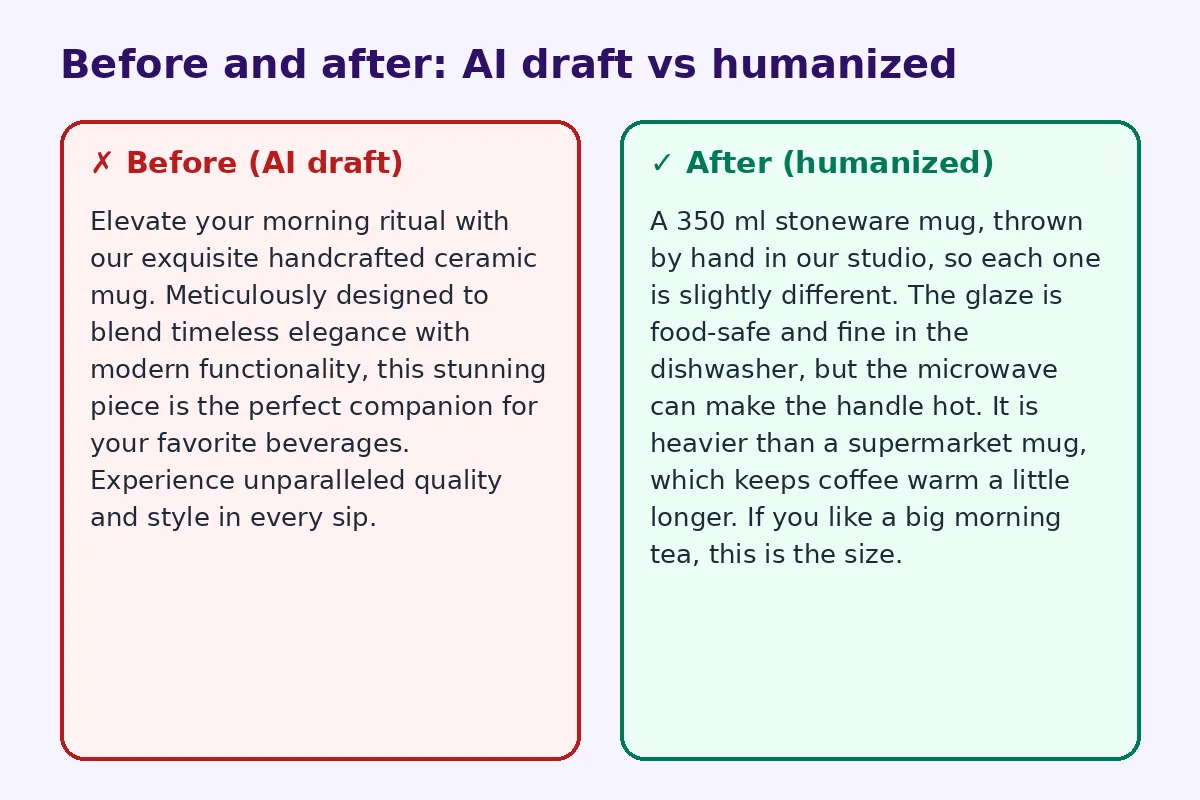
Here is a typical AI draft for a ceramic coffee mug, and a humanized version.
Before (AI draft):
Elevate your morning ritual with our exquisite handcrafted ceramic mug. Meticulously designed to blend timeless elegance with modern functionality, this stunning piece is the perfect companion for your favorite beverages. Experience unparalleled quality and style in every sip.
After (humanized):
A 350 ml stoneware mug, thrown by hand in our studio, so each one is slightly different. The glaze is food-safe and fine in the dishwasher, but the microwave can make the handle hot. It is heavier than a supermarket mug, which keeps coffee warm a little longer. If you like a big morning tea, this is the size.
The second version is not fancier. It is more useful. It has a size, a material, a care note, an honest drawback and a reason to buy.
Step 1: Give the AI the facts first
The quality of the output depends on the input. Before prompting, collect:
- Dimensions, weight, capacity or size range
- Materials and where it is made
- Care instructions
- Who it is for and how they use it
- Two or three things customers say in reviews
- Any honest limitations
Then prompt something like: "Write a 100-word product description using only these facts. Plain language, no hype words, mention one limitation." You will get a much better draft than from "write a product description for a mug".
Step 2: Cut the hype words
Go through the draft and delete or replace:
- "elevate", "unleash", "unlock"
- "exquisite", "luxurious", "stunning" (unless you can prove it)
- "perfect for any occasion"
- "seamlessly", "effortlessly"
- "in today's fast-paced world"
Replace each with a fact. "Stunning" becomes "deep blue glaze with a white rim". "Perfect for any occasion" becomes "a good gift for a coffee drinker who has everything".
Step 3: Use your customers' words
Read your reviews and support emails. Customers describe products in a way AI never will: "finally a backpack that doesn't hurt my shoulders", "my cat actually uses this". Borrow those phrases, or the problems behind them. It makes the copy feel familiar to the next buyer.
Step 4: Vary the sentence rhythm
AI tends to write sentences of the same length. Mix short lines with longer ones. Start one sentence with "But". Use a fragment if it sounds natural. Read the description out loud: if it sounds like an ad voiceover, it needs more editing.
Step 5: Add a small honest note
One small, honest caveat makes everything else more believable. "Runs slightly small, order one size up." "Not for very large dogs." It reduces returns and builds trust, which matters more than one extra adjective.
Step 6: Run it through a humanizer, then check
If you have many products, a humanizer for marketing copy can speed up the rewriting by varying phrasing and removing robotic patterns. Always check the result afterwards: make sure sizes, materials and care details are still correct, because no tool knows your product as well as you do.
Product descriptions and packaging
The description on your website is only one place customers read about the product. Many brands now add a QR code to the box or label that links back to the product page, setup video or care guide. If you are doing that, our sister site has a practical guide to QR codes on product packaging. Make sure the page the code opens has the same honest, human description, not a generic AI block.
SEO tips for humanized product copy
Humanizing your descriptions also helps search:
- Unique text. Edited copy is less likely to duplicate other stores using the same AI tool.
- Natural keywords. Use the words buyers search, such as "stoneware mug 350 ml", in a natural sentence.
- Useful details. Specific facts answer long-tail searches.
- Lower bounce. Clear descriptions keep shoppers on the page longer.
Google has said it cares about helpful content, not whether AI was involved. Our article on whether Google penalizes AI content explains this in more detail.
A simple template you can reuse
For most products, this structure works:
- One-line summary: what it is and who it is for.
- Two or three key facts: size, material, feature.
- The experience: what it is like to use.
- One honest note: fit, limitation or care tip.
- Specs list: for people who skim.
Feed this structure to the AI, fill in your facts, then edit the result using the steps above.
Working through a big catalog
If you have hundreds of products, do not try to hand-edit every one in a single week. Start with your top 20 sellers, since they bring the most traffic and revenue. Then handle each category with a shared set of facts and phrases, so the voice stays consistent. Keep a short style sheet with the words you use and the words you avoid, and share it with anyone who writes copy for the shop.
FAQ
Is it okay to use AI for product descriptions?
Yes. AI is a useful first draft tool. The problem is publishing raw output without adding real product details and editing the tone.
How long should a product description be?
Usually 80 to 200 words for the main text, plus a short spec list. Complex or expensive products may need more.
Will humanized product descriptions rank better?
Unique, specific and helpful descriptions tend to perform better than generic text that appears on many stores.
What words should I avoid in product descriptions?
Avoid hype words like "elevate", "exquisite", "unparalleled" and "seamless" unless you can back them with a fact.
Can a humanizer tool rewrite product descriptions?
Yes, a humanizer can vary wording and remove robotic phrasing quickly. Always check the facts afterwards.
Try FreeHumanizerAI for free
Humanize AI text instantly. No signup, up to 5,000 words per session, and your text is not stored.
Open AI HumanizerRelated guides
- GuideHow to Edit AI Content to Sound Natural: A Line-by-Line MethodA practical editing checklist for AI drafts, with worked examples. Fifteen minutes per article, no tricks, and the result reads like you wrote it.Read
- GuideDoes Google Penalize AI Content? What the Guidelines Actually Say in 2026Google's rule is about helpfulness, not authorship. Here is what the guidelines say, what gets sites hit, and a publishing checklist.Read
- GuideHow to Humanize an AI Blog Intro That Actually Hooks ReadersAI blog intros are generic and lose readers fast. Learn how to humanize your blog intro with a real hook, a clear promise and natural wording.Read