
How to Humanize an AI Scholarship Essay So It Sounds Like You
Used AI to draft a scholarship essay? Learn how to make it sound like you, with real stories, specific goals and your own voice. Before and after example.
Scholarship committees read hundreds of essays every cycle. Since AI tools became common, many of those essays have started to sound the same: "Ever since I was young, I have been passionate about making a difference." "This scholarship would allow me to pursue my dreams and give back to my community." Readers notice. An essay that could have been written by anyone is easy to put on the "no" pile.
If you used AI to brainstorm or draft your scholarship essay, you're not alone. The important part is what you do next. This guide shows you how to rewrite an AI draft so it tells your story in your voice, and how to stay within the rules of the scholarship you're applying for.
First, check the rules
Some scholarships allow AI for brainstorming and grammar. Others ban it completely. Read the application guidelines carefully. If you're not sure, ask the provider. Whatever the rules say, the final essay must be honest: your experiences, your goals and your words. A humanizer or editor should help you express your story, not invent one.
Why AI scholarship essays fall flat
AI drafts have common weaknesses:
- Generic passion statements. "I have always been passionate about helping others."
- No real story. Big claims, but no moment, place or person.
- Big, empty words. "Resilience", "perseverance", "make a difference", "unwavering commitment".
- Predictable structure. Childhood dream, challenge, lesson, thank you.
- Too polished. Every sentence is grammatically perfect and emotionally flat.
Our list of words that make text sound like AI covers many of these.
What committees actually look for
Scholarship readers want to understand:
- Who you are beyond your grades.
- A real challenge or experience, and what you did about it.
- Clear, believable goals.
- Why this scholarship matters for you specifically.
- Evidence that you'll use the opportunity well.
Specific details answer all of these better than general statements.
Before and after: a real rewrite
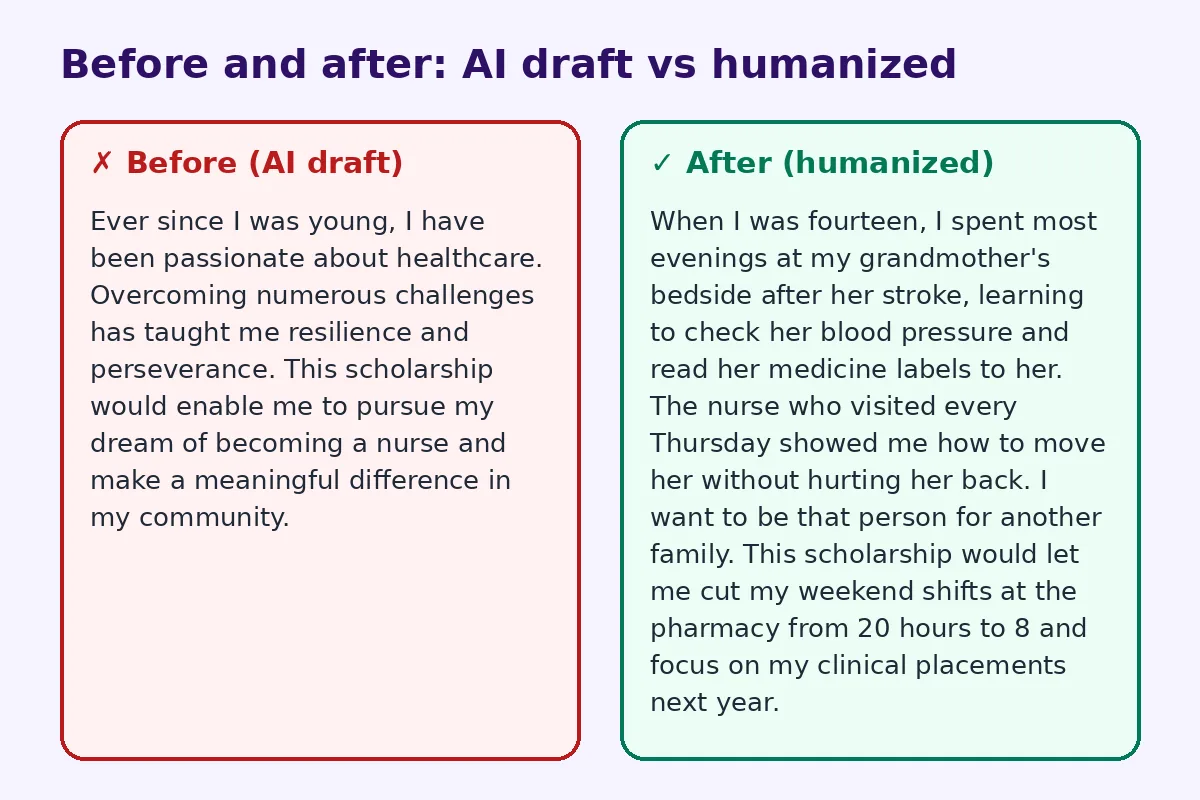
Before (AI draft):
Ever since I was young, I have been passionate about healthcare. Overcoming numerous challenges has taught me resilience and perseverance. This scholarship would enable me to pursue my dream of becoming a nurse and make a meaningful difference in my community.
After (humanized):
When I was fourteen, I spent most evenings at my grandmother's bedside after her stroke, learning to check her blood pressure and read her medicine labels to her. The nurse who visited every Thursday showed me how to move her without hurting her back. I want to be that person for another family. This scholarship would let me cut my weekend shifts at the pharmacy from 20 hours to 8 and focus on my clinical placements next year.
The second version has a real moment, a real person and a specific, practical goal. It's believable because it's detailed.
Step 1: Start with your own notes
Before editing the AI draft, write down quickly, without worrying about style:
- Three moments that shaped your goals
- One real challenge and what you did
- What you want to study and why
- What you'll do with the scholarship money, practically
- Anything about your background the committee should know
These notes are your raw material. The AI draft is just a frame.
Step 2: Replace every general claim with a story
Look for sentences like "I am hardworking" or "I care about my community". For each, ask: when did that show? Replace the claim with the moment. "I am hardworking" becomes "I studied for my chemistry finals on the bus between my two part-time jobs."
Step 3: Cut the big words
Delete or replace "resilience", "perseverance", "passionate", "unwavering", "journey" and "make a difference". Show these qualities through what you did. Committees prefer a quiet, specific story to a loud, vague one.
Step 4: Answer the prompt directly
AI drafts often drift. Re-read the prompt and make sure each paragraph helps answer it. If the question asks about a challenge, the challenge should be the center of the essay, not a side note.
Step 5: Make it sound like you
Read the essay out loud. Would you say it this way to a teacher you trust? Use your normal words. If you never say "furthermore", don't write it. A little informality is fine, as long as it's clear and respectful. Our guide on how to rewrite a ChatGPT essay in your own voice has more techniques.
Step 6: Be specific about the money
Many essays say the scholarship will "help me achieve my dreams". Say what it will actually change: fewer work hours, a laptop, a study abroad term, books, transport costs. Practical answers show the committee you've thought about it.
Step 7: Get a human reader
Ask a teacher, counselor or family member to read it. Ask them: "Does this sound like me?" and "What part do you remember?" If they can't remember anything specific, add more detail.
About AI detectors
Some scholarship programs use AI detection tools. These tools are not perfect, and they sometimes flag human writing. Our article on how accurate AI detectors are explains why. The best protection is simply writing an essay that's genuinely yours: specific stories, your own phrasing and your own structure. If you want to see how your draft reads, you can run it through an AI detector, but don't let a score replace honest editing.
Using a humanizer responsibly
A humanizer for students can help smooth phrasing or vary sentence rhythm in a draft you've already rewritten with your own story. Use it as an editing aid, within the scholarship's rules, never to disguise content that isn't yours. The story must come from you.
Personal statements and other essays
The same approach works for college personal statements, fellowship applications and grant essays. For more, read our guide on how to humanize an AI personal statement.
Common mistakes
- Submitting a draft with no real story.
- Exaggerating hardships or achievements.
- Ignoring the word limit.
- Using the same essay for every scholarship without adjusting it.
- Forgetting to thank the provider or mention why their scholarship specifically matters.
How to structure your rewrite
If your AI draft feels hard to fix, it can be easier to rebuild it around a simple structure:
- Open with a moment. One scene, in two or three sentences, that shows something important about you.
- Explain what it meant. What you learned, decided or changed because of it.
- Connect it to your goals. What you want to study or do, and why that moment led there.
- Show what you have already done. Classes, work, volunteering or projects that prove you are serious.
- Close with the scholarship. What it will practically change, and how you will use it.
Keep the AI draft open in a separate window and borrow only the sentences that still fit. Most of the time, you will end up keeping very little, and that is a good sign.
A final checklist
- Does the essay answer the prompt?
- Is there at least one specific story?
- Are your goals clear and realistic?
- Did you remove generic words?
- Does it sound like you when read aloud?
- Is it within the word limit?
FAQ
Is it allowed to use AI for a scholarship essay?
It depends on the scholarship. Read the rules. Many allow brainstorming or grammar help, and some ban AI completely.
How do I make my scholarship essay sound less like AI?
Replace general claims with specific stories, cut buzzwords, and write the way you speak.
Can scholarship committees detect AI?
Some use AI detectors, which are not always accurate. Readers also notice generic writing quickly.
How long should a scholarship essay be?
Follow the word limit given. Many are between 300 and 650 words.
Should I mention financial need?
If it's relevant to the prompt, be honest and specific about what the scholarship would change.
Try FreeHumanizerAI for free
Humanize AI text instantly. No signup, up to 5,000 words per session, and your text is not stored.
Open AI HumanizerRelated guides
- GuideHow to Make an AI-Drafted Personal Statement Sound Like YouUsed ChatGPT for your personal statement? Rewrite it in your own voice, add real stories, and drop the generic AI tone admissions readers spot.Read
- GuideHow to Rewrite a ChatGPT Essay in Your Own Voice (Without Losing the Argument)Used ChatGPT for a first draft? Here is how to make the essay yours, keep the argument, and stay inside your course's AI policy.Read
- GuideCan Turnitin Detect AI Writing? What Students Should Know in 2026Turnitin does flag AI writing, with limits. Here is how the indicator works, where it is weak, and what the score means for a student.Read