How to Humanize an AI Cold Email So People Actually Reply
AI cold emails all sound the same. How to humanize an AI cold email with real details, a short ask and a natural tone, with examples.
AI can write a cold email in five seconds. That is exactly the problem. Every inbox is now full of emails that open with "I hope this message finds you well", praise the company's "innovative approach", and close with "Would you be open to a quick 15-minute call?" Prospects have seen that template a thousand times, and they delete it without reading the second line.
You do not need to stop using AI for outreach. You need to stop sending what it gives you as-is. This guide shows how to turn an AI cold email into something that reads like a real person wrote it, for one real reason, to one real reader.
Why AI cold emails get ignored
Most AI outreach fails for the same handful of reasons:
- Generic flattery. "I was impressed by your company's commitment to excellence" could be sent to anyone.
- Long intros. Three sentences before the reader learns why you are writing.
- Buzzwords. "Leverage", "streamline", "synergy", "unlock growth". Our list of words that make text sound like AI covers the worst offenders.
- A big ask. A 30-minute demo from a stranger is a lot to ask.
- Perfect but empty. No typos, but also no facts, numbers or names.
Spam filters and busy people reward the opposite: short, specific, plain emails.
The structure of a cold email that works
Keep it to four parts and under 120 words:
- A specific reason for writing. Something you noticed about them: a job post, a product launch, a talk, a review.
- One line about the problem you solve. In their words, not yours.
- Proof. A result, a client type, a number.
- A small ask. A yes or no question, or an offer to send something useful.
AI is good at producing a structure like this if you give it the facts. It is bad at inventing facts it does not have. So your job is to feed it the details, then edit.
Step 1: Give the AI real inputs
Instead of "write a cold email to a marketing manager", give it:
- who the person is and what they posted or launched
- what you offer, in one sentence
- one real result you got for a similar client
- the exact ask
The more specific your prompt, the less generic the draft. Even then, treat the output as a first draft.
Step 2: Cut the opener and the closer
Delete any line like:
- "I hope this email finds you well."
- "My name is X and I work at Y."
- "I wanted to reach out because..."
- "Looking forward to hearing from you."
Start with the reason you are writing. End with the question. Your name is already in the signature.
Step 3: Replace adjectives with facts
AI writes "we help companies achieve remarkable growth". A human writes "we helped a 12-person bakery chain cut delivery complaints by a third". Go through the draft and replace every vague adjective with a number, a name or an example. If you don't have one, delete the claim.
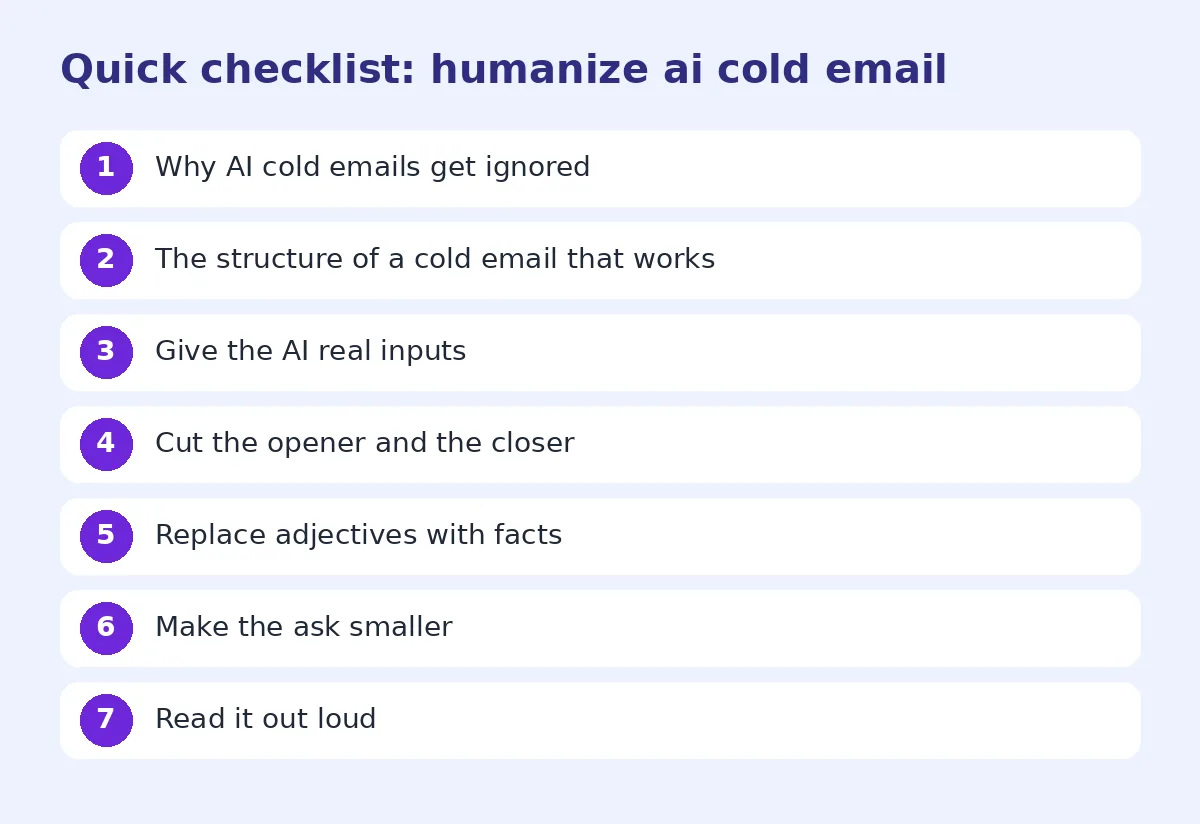
Step 4: Make the ask smaller
"Would you be open to a 30-minute call next week?" is a big commitment. Smaller asks get more replies:
- "Worth a look?"
- "Want me to send the two-page breakdown?"
- "Is this something you are handling already?"
Step 5: Read it out loud
If it sounds like a press release, rewrite it. Use contractions. Use short sentences. One sentence fragment is fine. Write like you would talk to someone at a conference.
If you have many emails to fix, our free AI humanizer can rewrite stiff AI phrasing into a more natural tone in seconds. You still add the personal detail at the top.
Before and after example
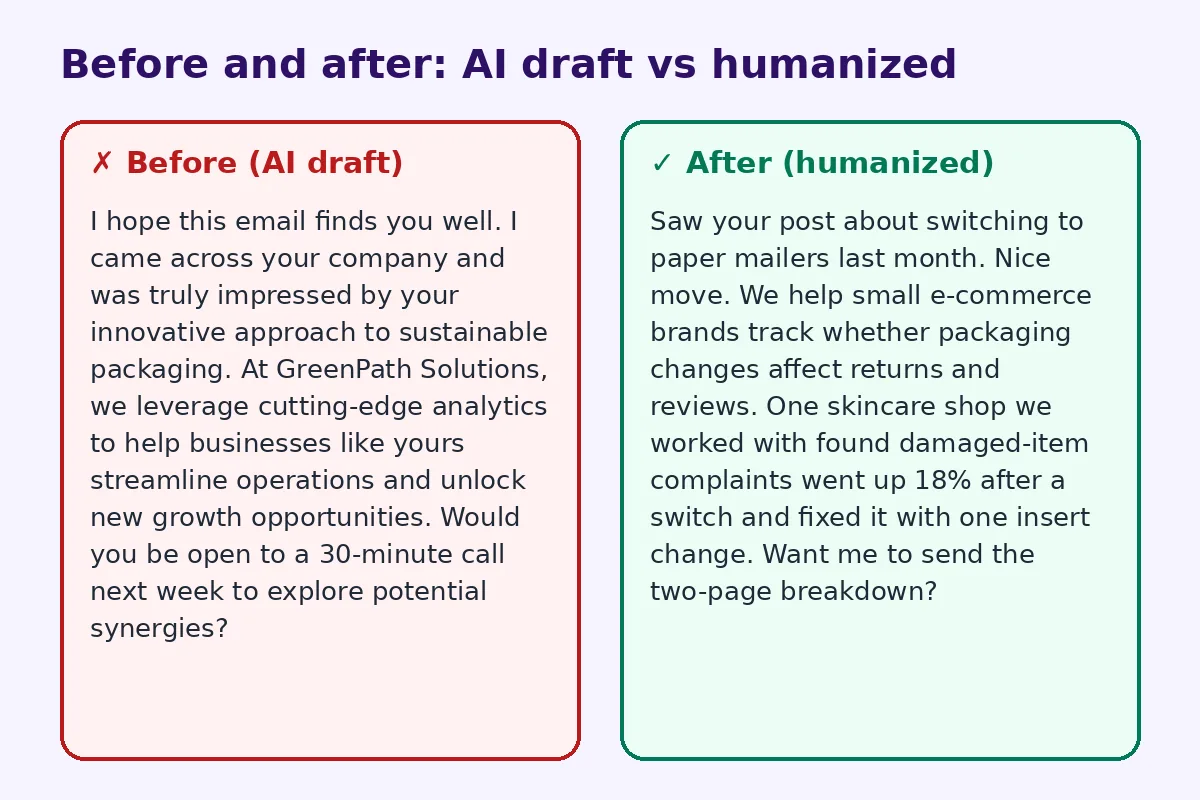
Before (AI draft):
I hope this email finds you well. I came across your company and was truly impressed by your innovative approach to sustainable packaging. At GreenPath Solutions, we leverage cutting-edge analytics to help businesses like yours streamline operations and unlock new growth opportunities. Would you be open to a 30-minute call next week to explore potential synergies?
After (humanized):
Saw your post about switching to paper mailers last month. Nice move. We help small e-commerce brands track whether packaging changes affect returns and reviews. One skincare shop we worked with found damaged-item complaints went up 18% after a switch and fixed it with one insert change. Want me to send the two-page breakdown?
The second version is shorter, mentions something real, gives a concrete result and asks for something easy.
Personalize at scale without sounding fake
You can still send many emails. Use a simple rule: one real line per prospect. Write that line yourself, from their website, LinkedIn or recent news, and let the rest of the email be a well-edited template.
Avoid fake personalization like "I loved your recent post!" when you didn't read it. People can tell, and it does more harm than no personalization.
Do not forget the signature
A clean, human signature helps too. Include your name, role, company and one way to reach you. If you meet people in person or send printed proposals, a small QR code that saves your contact is handy. qrfyy has a guide on adding a QR code for your email signature that keeps it small and scannable.
Follow-ups that sound human
AI follow-ups are often worse than the first email: "Just circling back to see if you had a chance to review my previous email." Instead:
- Add one new piece of value: a short tip, a relevant link, a quick idea.
- Keep it to two or three lines.
- Stop after two or three follow-ups.
Example: "One more idea: your returns page doesn't mention packaging. Adding one line there cut questions by half for a client of ours. Happy to share the wording."
Checklist before you hit send
- Is the first line about them, not you?
- Is it under 120 words?
- Is there at least one real number or example?
- Did you remove buzzwords and stock phrases?
- Is the ask small?
- Would you say this out loud to them?
For more general editing tips, read how to edit AI content to sound natural, and if you write sales copy as well, try the marketing copy humanizer.
FAQ
Is it okay to use AI for cold emails?
Yes. It is a good way to draft structure and variations. Just add real details and edit the tone before sending.
How long should a cold email be?
Under 120 words is a good target. Many of the best-performing cold emails are 50 to 90 words.
Will humanizing my cold email help with spam filters?
Shorter, plain-text emails with fewer marketing phrases and links tend to land better, though deliverability also depends on your domain setup and sending volume.
What is the best subject line for a cold email?
Short and specific, often lowercase and two to four words, such as "paper mailers" or "returns question". Avoid clickbait.
How many follow-ups should I send?
Two or three, a few days apart, each adding something new. Then stop.
Try FreeHumanizerAI for free
Humanize AI text instantly. No signup, up to 5,000 words per session, and your text is not stored.
Open AI HumanizerRelated guides
- GuideHow to Make an AI Cover Letter Sound Human (and Actually Get Read)Turn a ChatGPT cover letter into one that sounds like you. Cut AI phrases, add real proof, fix the opening, and check the tone before you apply.Read
- GuideHow to Edit AI Content to Sound Natural: A Line-by-Line MethodA practical editing checklist for AI drafts, with worked examples. Fifteen minutes per article, no tricks, and the result reads like you wrote it.Read
- GuideHow to Humanize AI LinkedIn Posts (So People Actually Engage)AI LinkedIn posts all sound the same. Learn how to humanize them: fix the hook, cut the clichés, add real stories, and format for the feed.Read