
How to Humanize AI Thank-You Notes So They Feel Genuinely Personal
AI thank-you notes sound generic and cold. Learn how to humanize AI thank-you notes for customers, gifts, interviews and work so they feel sincere.
A thank-you note is one of the simplest ways to make someone feel appreciated. It's also one of the easiest things to get wrong with AI. Ask a tool for a thank-you message and you'll usually get something like: "Thank you so much for your thoughtful gift. Your kindness means the world to me, and I truly appreciate your generosity." It's pleasant, but it could have been sent to anyone, for anything. The person reading it can tell.
The good news: a sincere thank-you note only needs two or three specific sentences. This guide shows how to turn an AI draft into a note that sounds like you, for customers, gifts, interviews, colleagues and teachers.
Why AI thank-you notes feel empty
AI thank-you notes share common patterns:
- Generic gratitude. "Thank you for your kindness and generosity."
- No specifics. The gift, help or moment isn't named.
- Overly emotional language. "Means the world to me", "forever grateful", "words cannot express".
- Too formal. Phrases you'd never say out loud.
- Same note for everyone. Nothing personal to the recipient.
See our list of words that make text sound like AI for more phrases to watch for.
The simple formula for a great thank-you note
Most good thank-you notes follow three steps:
- Thank them for something specific. Name the gift, favor or help.
- Say why it mattered or how you'll use it. One real detail.
- Look forward. A warm line about seeing them, working together, or what comes next.
That's often just three sentences.
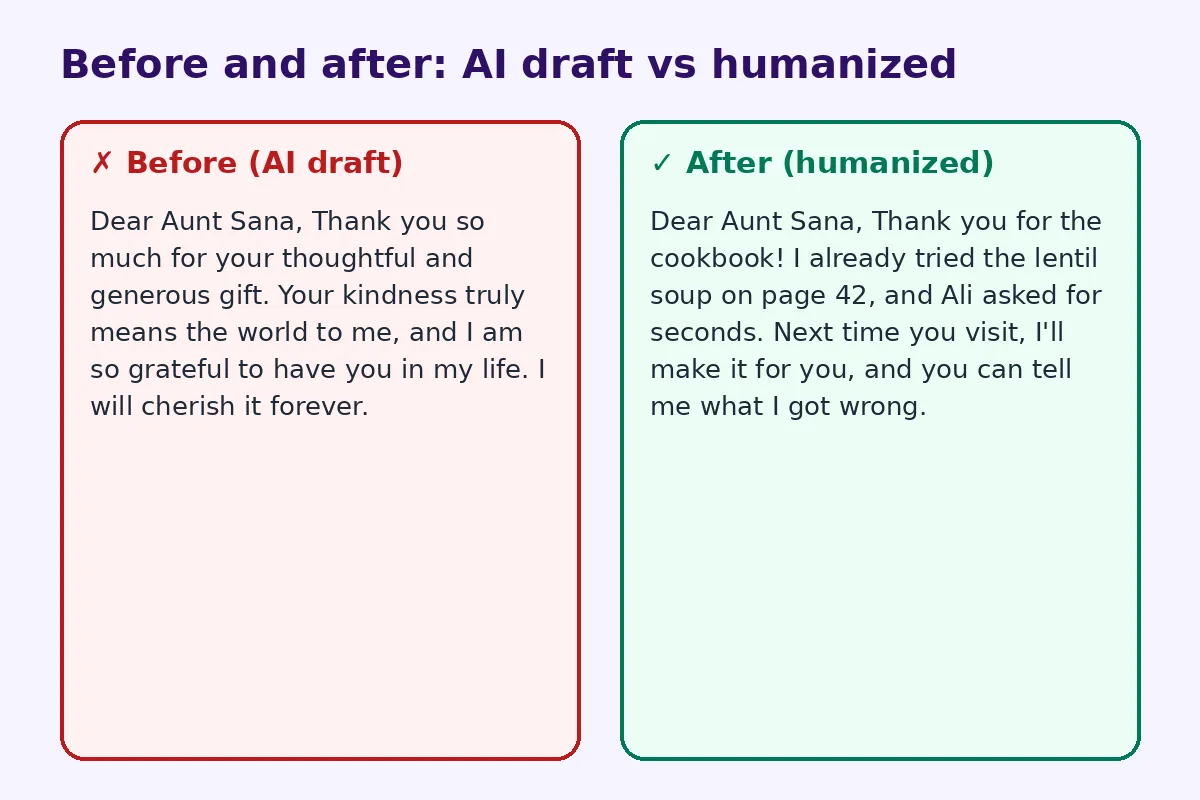
Before and after: a gift thank-you
Before (AI draft):
Dear Aunt Sana, Thank you so much for your thoughtful and generous gift. Your kindness truly means the world to me, and I am so grateful to have you in my life. I will cherish it forever.
After (humanized):
Dear Aunt Sana, Thank you for the cookbook! I already tried the lentil soup on page 42, and Ali asked for seconds. Next time you visit, I'll make it for you, and you can tell me what I got wrong.
The second note names the gift, shares a real moment and ends with a warm, personal line.
Step 1: Write down the specific details
Before using AI, note:
- What exactly they gave or did
- When and where
- How you used it, or what difference it made
- Something personal about your relationship
These details are what make a note feel real.
Step 2: Replace general phrases
Delete "your kindness means the world to me" and "I am so grateful". Replace with the specific thing: "The blanket is already on the sofa, and the cat has claimed it."
Step 3: Keep it short
A thank-you note doesn't need to be long. Three to five sentences is plenty for most situations. A short, specific note beats a long, generic one.
Step 4: Write how you speak
Read the note out loud. If it sounds stiff, loosen it. Use contractions. Use the nickname you actually use. Add a bit of humor if that's normal between you.
Thank-you notes for different situations
Customers (small businesses): "Hi Maria, thanks for ordering the blue ceramic bowls. I packed them myself and hope they arrived safely. If you ever need a matching set of mugs, just reply to this email. – Hina"
After a job interview: "Hi Mr. Khan, thank you for taking the time to talk with me today about the marketing coordinator role. I especially enjoyed hearing about the new product launch in spring. I'd love to help with that project and look forward to hearing from you."
To a colleague: "Thanks for covering my calls on Friday. I know it was a busy day. Coffee's on me this week."
To a teacher: "Thank you for staying after class to help me with the essay. I finally understand what a thesis statement is supposed to do, and I got a B+!"
For a wedding gift: "Thank you for the lovely serving platter. We used it for our first dinner party, and everyone asked where we got it. We're so glad you could celebrate with us."
Thank-you notes for small businesses
For online sellers, a handwritten or printed thank-you note in each order builds loyalty and repeat sales. Keep the message short and personal, and consider adding a small card with a code to reorder, leave a review or get a discount. Our sister site has a practical guide to QR code parcel inserts for online sellers that shows how to combine a thank-you card with a QR code customers can scan.
If you send many notes, write a short template with blanks for the customer's name and product, and add one personal line to each.
Using AI and humanizers wisely
AI can help when you have many notes to write, for example after a wedding or a big event. Give it the specific details for each person and ask for a short draft in a casual tone. Then edit each one. An AI humanizer can quickly remove stiff phrasing if you're writing dozens of notes, but the personal details must come from you.
For business messages, see our guide on how to edit AI content to sound natural.
Handwritten vs. digital
Handwritten notes feel more personal, especially for gifts, weddings and interviews in traditional industries. Email or messaging is fine for quick thanks at work or after a casual favor. For customers, a printed card in the package works well. Whatever the format, specificity matters more than paper.
Timing
Send thank-you notes soon:
- Job interviews: within 24 hours
- Gifts: within a week or two
- Weddings: within a few months is traditional, sooner is better
- Customers: in the package or right after delivery
Write a batch without losing the personal touch
After a wedding, graduation or big event, you may need to write fifty notes. Make a simple list first: each person's name, what they gave or did, and one personal detail. Then write in small batches of five or ten, so your tone stays fresh. If you use AI to start, paste in one row at a time rather than asking for fifty notes at once. Read each finished note before moving on. It takes longer than a single template, but every guest gets a note that clearly belongs to them, and that is what people remember.
Common mistakes
- Not naming the gift or favor.
- Overly emotional, generic phrases.
- Sending the same note to everyone.
- Waiting too long.
- Misspelling the person's name.
A quick checklist
- Did you name what you're thanking them for?
- Did you add one specific detail?
- Is it short?
- Does it sound like you?
- Is the name spelled correctly?
FAQ
Can I use AI to write thank-you notes?
Yes, as a starting point. Add the specific details and your own voice before sending.
How long should a thank-you note be?
Usually three to five sentences.
What should a thank-you note include?
What you're thanking them for, why it mattered, and a warm closing line.
How soon should I send a thank-you note after an interview?
Within 24 hours.
Should small businesses send thank-you notes?
Yes. A short, personal note in each order builds loyalty and repeat customers.
Try FreeHumanizerAI for free
Humanize AI text instantly. No signup, up to 5,000 words per session, and your text is not stored.
Open AI HumanizerRelated guides
- GuideHow to Humanize an AI Apology Email So It Actually Sounds SorryAI apology emails sound cold and scripted. Learn how to humanize an AI apology email so it sounds sincere, takes responsibility and fixes the problem.Read
- GuideHow to Humanize AI Email Replies So You Still Sound Like YouAI email replies sound robotic and over-polite. Learn how to humanize AI email replies so they're short, clear and natural, with examples.Read
- GuideHow to Edit AI Content to Sound Natural: A Line-by-Line MethodA practical editing checklist for AI drafts, with worked examples. Fifteen minutes per article, no tricks, and the result reads like you wrote it.Read