How to Humanize an AI Fundraising Letter So People Actually Give
AI fundraising letters sound generic and raise less. Learn how to humanize an AI fundraising letter with a real story, a clear ask and a warm tone.
Fundraising letters work when people feel something. A donor reads about one child, one family, one animal or one neighborhood, and decides to help. AI can write a fundraising letter in seconds, but it usually produces something like: "Together, we can make a meaningful difference in the lives of those in need. Your generous support will help us continue our vital mission." It sounds fine, and it raises very little. Donors have read that paragraph a hundred times.
Charities, schools, churches, clubs and community groups can still use AI to save time. The key is to replace the generic parts with real stories, real numbers and a clear, specific ask. This guide shows you how.
Why AI fundraising letters underperform
AI drafts have common problems:
- Abstract language. "Those in need", "vital mission", "make a difference".
- No story. Big statements without a single person or moment.
- No numbers. Donors don't know what their gift will do.
- Weak ask. "Please consider supporting us" instead of a clear amount and purpose.
- Organization-centered. "We have achieved..." instead of "You can help..."
- Too long and formal. Readers skim and stop.
Our list of words that make text sound like AI includes many of the phrases that show up in appeal letters.
The structure of a strong fundraising letter
Most effective appeals follow a simple flow:
- Open with a story. One person, one moment, one problem.
- Show the need. Why this matters now, with a real number or fact.
- Make the ask. A specific amount and what it will do.
- Show the impact. What will change because of the gift.
- Make it easy to give. One clear way to donate.
- Say thank you. Warmly and personally.
- Add a P.S. Many donors read it first. Repeat the ask.
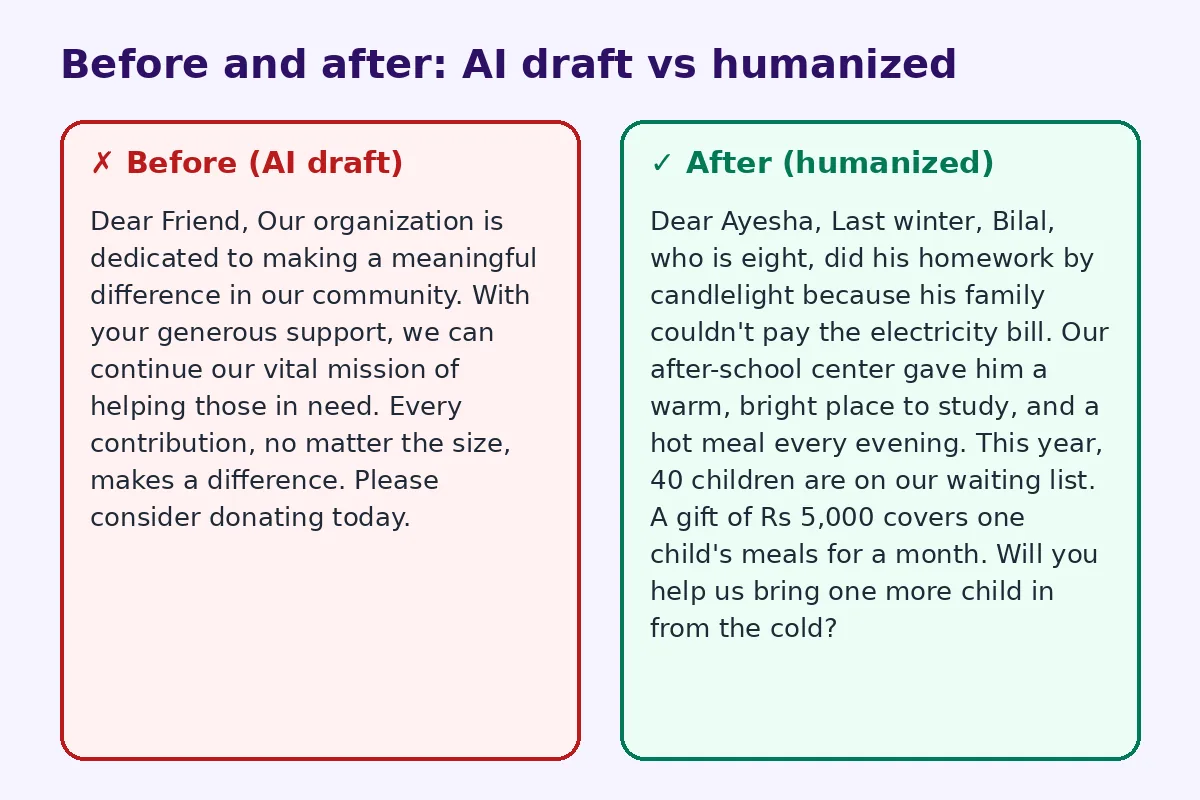
Before and after: a real rewrite
Before (AI draft):
Dear Friend, Our organization is dedicated to making a meaningful difference in our community. With your generous support, we can continue our vital mission of helping those in need. Every contribution, no matter the size, makes a difference. Please consider donating today.
After (humanized):
Dear Ayesha, Last winter, Bilal, who is eight, did his homework by candlelight because his family couldn't pay the electricity bill. Our after-school center gave him a warm, bright place to study, and a hot meal every evening. This year, 40 children are on our waiting list. A gift of Rs 5,000 covers one child's meals for a month. Will you help us bring one more child in from the cold?
The humanized letter has a person, a place, a number and a specific ask. It's much easier to say yes to.
Step 1: Gather real stories and facts
Before using AI, collect:
- One story about a person you helped (with permission and privacy in mind)
- Specific numbers: people served, cost per person, waiting lists
- What a specific gift amount achieves
- A deadline or urgent reason to give now
- How to donate
Step 2: Lead with one person
Start with a short story about one person, not statistics about thousands. People connect with individuals. Change names or details if needed to protect privacy, and say so.
Step 3: Make the ask specific
Instead of "please consider supporting us", write "Will you give Rs 5,000 today to cover one child's meals for a month?" Offer two or three levels if you like, each linked to a clear result.
Step 4: Write to "you"
Shift from "we did" to "you can". "Your gift will keep the lights on" is more powerful than "our organization provides electricity support". The donor should feel like the hero of the story.
Step 5: Cut the jargon
Remove "stakeholders", "beneficiaries", "capacity building", "holistic approach" and "vital mission". Use the words you'd use talking to a friend: "kids", "families", "meals", "a safe place".
Step 6: Make giving easy
Include one clear, simple way to give: a website link, a bank transfer reference or a donation QR code. Don't make donors search for it.
Many churches, schools and charities now print a QR code on their letters, envelopes and event posters so donors can give from their phone in seconds. Our sister site has a practical guide to QR codes for churches and fundraisers that explains how to set one up safely.
Step 7: Add a P.S.
The P.S. is one of the most-read parts of a letter. Use it to repeat the ask and the deadline: "P.S. Your gift before 31 December will be matched, so Rs 5,000 becomes Rs 10,000."
Email appeals
The same principles apply to fundraising emails, but shorter:
- A personal, specific subject line ("Bilal did his homework by candlelight")
- A short story
- A single "Donate" button
- A brief P.S.
Thank donors properly
After someone gives, thank them quickly and personally. Tell them what their gift did. A good thank-you message makes the next gift much more likely. See our guide on how to humanize AI thank-you notes for tips and examples.
Using AI and humanizers responsibly
AI can draft the structure, suggest subject lines and adjust tone. Give it your real story and numbers, and ask for a warm, plain-language draft. An AI humanizer or our marketing copy humanizer can make the final wording sound more natural, especially if you send many appeals a year. Always check facts, names and amounts before sending, and never invent stories or numbers.
Ethics and privacy
- Get permission before sharing someone's story or photo.
- Change names and identifying details when needed.
- Don't exaggerate need or impact.
- Be transparent about how donations are used.
Segment your letters
Not every donor should get the same letter. A first-time donor, a monthly supporter and someone who gave a large gift last year each need a slightly different message. Thank returning donors for their past support and tell them what it achieved before making the new ask. For new prospects, spend a little more time on who you are and why the need is real. AI can help you create versions for each group quickly, but keep the same true story at the heart of each one.
A sample one-page letter outline
Here is a simple outline you can follow. Paragraph one: the story of one person, in four or five short sentences. Paragraph two: the wider need, with one clear number, such as the length of a waiting list. Paragraph three: the ask, with an amount and exactly what it pays for. Paragraph four: how to give, with the website or QR code. Then a warm sign-off from a real person, with their name and role, and a short P.S. repeating the ask and any deadline.
Common mistakes
- No story, just statistics.
- Vague asks.
- Letters that talk only about the organization.
- Long, formal paragraphs.
- No clear way to donate.
- Forgetting the thank-you.
FAQ
Can I use AI to write a fundraising letter?
Yes, as a draft. Add a real story, specific numbers and a clear ask, then edit for a warm tone.
How long should a fundraising letter be?
Usually one page for print, shorter for email.
What makes a fundraising letter effective?
A personal story, a specific ask, clear impact and an easy way to give.
Should I include a QR code in my fundraising letter?
Yes, it makes giving from a phone fast and easy. Place it next to the ask.
How do I thank donors?
Quickly and personally, telling them what their gift achieved.
Try FreeHumanizerAI for free
Humanize AI text instantly. No signup, up to 5,000 words per session, and your text is not stored.
Open AI HumanizerRelated guides
- GuideHow to Humanize an AI Cold Email So People Actually ReplyAI cold emails all sound the same. How to humanize an AI cold email with real details, a short ask and a natural tone, with examples.Read
- GuideHow to Edit AI Content to Sound Natural: A Line-by-Line MethodA practical editing checklist for AI drafts, with worked examples. Fifteen minutes per article, no tricks, and the result reads like you wrote it.Read
- GuideHow to Humanize an AI Newsletter So People Keep Opening ItAI-written newsletters feel generic and drive unsubscribes. Here is how to humanize an AI newsletter with your voice, real stories and simple edits.Read